
Major points:
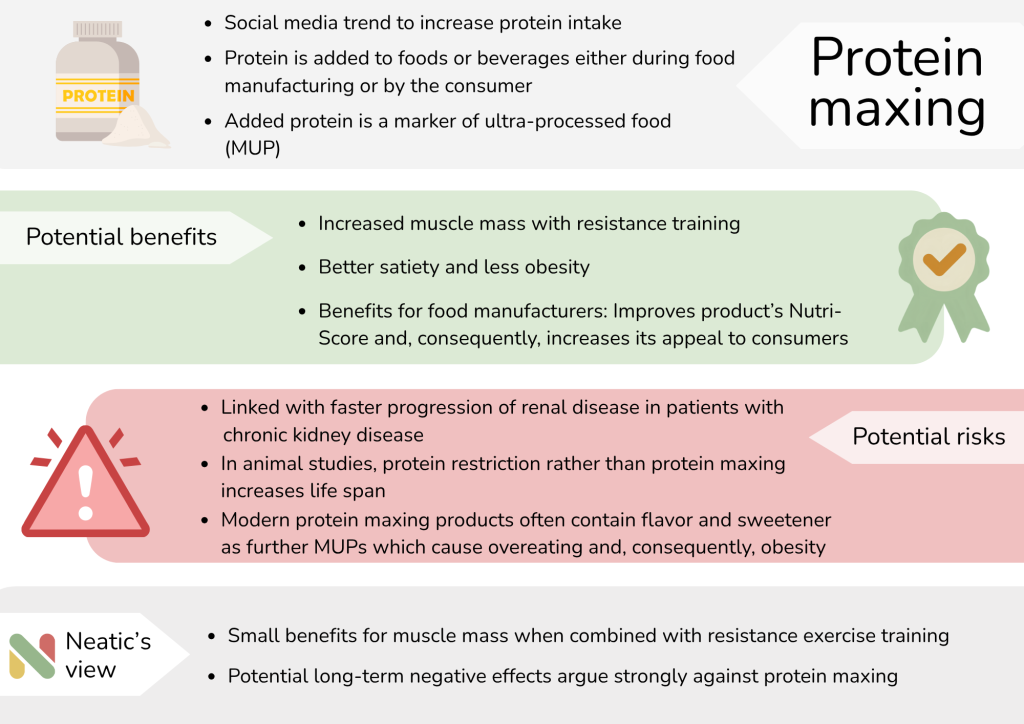
- Protein maxing, also known as proteinmaxing, proteinmaxxing, high-protein trend, or protein hype, is the practice of consuming products with artificially added protein in addition to a normal diet.
- Added protein is a marker of ultra-processed food (MUP), and many products with added protein, such as shakes, bars, and powders, also contain additional MUPs, including added flavor, sweetener, and coloring agent.
- Natural protein intake is typically more than sufficient in most developed countries. Protein maxing provides only marginal benefits but carries potential long-term risks including renal disease, decreased life expectancy, and obesity.
What is protein?
Detailed information about protein is available here. In short, protein is a macronutrient that not only provides 4 kcal of energy per gram but also performs essential functions such as transporting oxygen, enabling muscle contraction, and defending the body against pathogens.
Unlike carbohydrates, several of the amino acids that make up protein are essential. This means that these amino acids must come from the diet because the body cannot produce them on its own. Therefore, consuming a certain amount of protein is necessary to maintain good health.
What is protein maxing?
Protein maxing is a shortcut for increasing protein intake. It involves adding isolated protein to products such as shakes, bars, and powders either by the manufacturer or the consumer. Protein is commonly isolated from milk (as whey or casein), soy, and peas. In 2025, the global market for high protein-based food products had a volume of just under 30 billion dollars. Recent trends show an increasing consumption of protein-enriched snacks and beverages, reflecting modern, fast-paced lifestyles. For example, many high-protein bars have recently entered the market and are promoted as healthy food choices.
Furthermore, protein maxing has become one of the main nutrition-related topics on social media. Rather than being presented as one nutrient among many, protein is often portrayed as a simple solution to complex problems. Social media content creators frequently rely on oversimplification (e.g., “lose weight = increase protein intake”), clear-cut comparisons (e.g., “correct” vs. “wrong” behavior with little room for nuance), emotional narratives (e.g., success vs. failure), and information presented out of context (e.g., without considering overall energy intake or lifestyle). At the same time, processed high protein products have a high visibility on social media. This increased attention to protein may contribute to consumer demand, which is reflected in the growing availability of protein-enriched products on the market.
What are the potential benefits of protein maxing?
Increased muscle mass
Muscle mass, for which lean body mass is a marker, is an obvious target because muscle is primarily made up of protein. Therefore, the advertised role of protein maxing in increasing muscle mass is physiologically plausible. A recent meta-analysis of 48 studies found that, when combined with resistance exercise training, muscle mass increased significantly by 1.05 kg in the protein maxing group compared with the standard diet group. In the absence of resistance training, protein maxing resulted in only a non-significant increase of 0.15 kg in muscle mass. Muscle mass did not increase further when protein maxing exceeded 1.6 g of protein per kg of body weight per day.
Better satiety and less obesity
Protein is thought to promote greater satiety than carbohydrates and fat by stimulating the satiety hormones peptide YY (PYY) and glucagon-like peptide-1 (GLP-1), suppressing the hunger hormone ghrelin, and slowing gastric emptying. However, a recent meta-analysis showed that these effects are detectable only in the short term. In long-term interventions, protein maxing had no significant effect on hunger, fullness, desire to eat, prospective food consumption, satiety, PYY, or ghrelin, while GLP-1 levels even decreased significantly. In another meta-analysis, body weight was not significantly affected by protein maxing.
Importantly, many of the intervention studies included in these meta-analyses were funded by manufacturers of protein maxing products, and industry-sponsored nutrition studies are more likely to report conclusions favorable to the sponsor than independently funded studies.
Better Nutri-Score
Protein maxing also offers benefits for food manufacturers. Because protein is considered a favorable nutrient in the Nutri-Score, adding isolated protein can improve a product’s Nutri-Score and, consequently, increase its appeal to consumers.
Furthermore, there are also financial benefits for food manufacturers. A cross-sectional market analysis of high-protein food products in German supermarkets and online shops found that high-protein products were, on average, 132 % more expensive than their conventional counterparts.
What are the potential risks of protein maxing?
Renal disease
High protein intake has been linked with faster progression of renal disease in patients with chronic kidney disease. One mechanism is that the metabolism of amino acids generates a net acid load and phosphate, both of which must be excreted by the kidneys, thereby increasing the demand on renal excretory function.
A recent meta-analysis that did not show adverse effects of protein maxing on renal function is often cited as proof of the safety of the intervention. However, the authors of the paper correctly pointed out that no intervention study lasting longer than two years has been performed so far. Therefore, protein maxing is probably safe for up to several years in most healthy individuals; however, adverse effects at later time points are entirely possible and mechanistically plausible.
Decreased life span
A recent review shows convincingly that protein restriction rather than protein maxing increases life span in several animal models. Thus, chronic protein overconsumption may not only fail to provide additional physiological benefits once protein requirements are met but could also interfere with longevity-promoting pathways. Proposed mechanisms underlying the life-span-extending effects of protein restriction include reduced activation of the mechanistic target of rapamycin pathway, enhanced autophagy, and improved metabolic resilience.
Ultra-processed food, energy overconsumption, and obesity
According to the NOVA classification, added protein is a marker of ultra-processed food (MUP). Therefore, by definition, every protein maxing product is an ultra-processed food item. Even worse, modern protein maxing products typically incorporate isolated protein into an ultra-processed food matrix.
Evidence from a cross-sectional market analysis of high-protein ultra-processed food products in German supermarkets and online shops further highlights differences in their nutritional composition compared with conventional counterparts. High-protein ultra-processed food products had a lower energy density and lower contents of sugar, total fat, and saturated fat, whereas protein and fiber contents were higher. However, they also contained more salt and a higher number of MUPs, particularly flavor and sweetener. For example, protein shakes and bars often contain the MUPs flavor and sweetener both of which cause overeating and obesity.
If protein maxing leads to energy intake beyond requirements, body weight gain in the form of obesity with adipose tissue expansion is possible. Amino acids consumed during protein maxing are by no means necessarily converted into body protein but can also be converted into body fat.
What does Neatic recommend concerning protein maxing?
Protein maxing has more downsides than upsides. Small benefits exist with regard to increases in muscle mass when combined with resistance exercise training. However, the potential long-term negative effects on renal function, life span, and body weight control argue strongly against protein maxing, especially considering that natural protein intake is typically more than sufficient in most developed countries. In addition, various protein maxing products contain MUPs like added flavor and sweetener, and should therefore be avoided.
Bibliography
Chartres, Nicholas; Fabbri, Alice; Bero, Lisa A. (2016): Association of Industry Sponsorship With Outcomes of Nutrition Studies: A Systematic Review and Meta-analysis. JAMA Intern Med 176 (12), pp. 1769–1777. DOI: 10.1001/jamainternmed.2016.6721.
Kidney Disease: Improving Global Outcomes (KDIGO) CKD Work Group (2024): KDIGO 2024 Clinical Practice Guideline for the Evaluation and Management of Chronic Kidney Disease. Kidney Int 105 (4S), S117-S314. DOI: 10.1016/j.kint.2023.10.018.
Knopf, Bailey A.; Lamming, Dudley W. (2026): The hallmarks of protein and amino acid restriction in aging and longevity. Cell press blue 1 (5). DOI: 10.1016/j.cpblue.2026.100079.
Kohanmoo, Ali; Faghih, Shiva; Akhlaghi, Masoumeh (2020): Effect of short- and long-term protein consumption on appetite and appetite-regulating gastrointestinal hormones, a systematic review and meta-analysis of randomized controlled trials. Physiol Behav 226, p. 113123. DOI: 10.1016/j.physbeh.2020.113123.
Koop, Jana; Fedde, Svenja; Hägele, Franziska A.; Beunink, Christina; Müller, Manfred J.; Bosy-Westphal, Anja (2024): Nutritional value and environmental aspects of high-protein ultra-processed foods on the German market. Public Health Nutr 27 (1), e211. DOI: 10.1017/S1368980024001836.
Morton, Robert W.; Murphy, Kevin T.; McKellar, Sean R.; Schoenfeld, Brad J.; Henselmans, Menno; Helms, Eric; Aragon, Alan A.; Devries, Michaela C.; Banfield, Laura; Krieger, James W.; Phillips, Stuart M. (2018): A systematic review, meta-analysis and meta-regression of the effect of protein supplementation on resistance training-induced gains in muscle mass and strength in healthy adults. Br J Sports Med 52 (6), pp. 376–384. DOI: 10.1136/bjsports-2017-097608.
Nelson, David L.; Cox, Michael M. (2005): Lehninger principles of biochemistry. 4th ed. New York: W. H. Freeman.
Remer, Thomas; Kalotai, Nicole; Amini, Anna M.; Lehmann, Andreas; Schmidt, Annemarie; Bischoff-Ferrari, Heike A.; Egert, Sarah; Ellinger, Sabine; Kroke, Anja; Kühn, Tilman; Lorkowski, Stefan; Nimptsch, Katharina; Schwingshackl, Lukas; Zittermann, Armin; Watzl, Bernhard; Siener, Roswitha (2023): Protein intake and risk of urolithiasis and kidney diseases: an umbrella review of systematic reviews for the evidence-based guideline of the German Nutrition Society. Eur J Nutr 62 (5), pp. 1957–1975. DOI: 10.1007/s00394-023-03143-7.