
Major points:
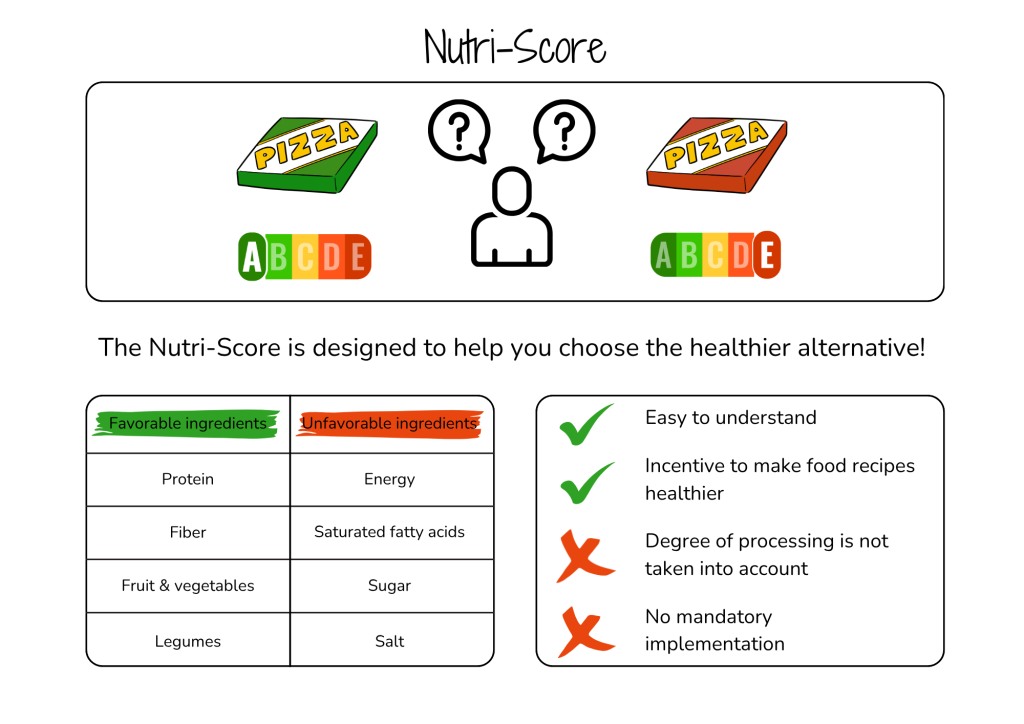
- The Nutri-Score is a form of nutrition labeling and can help you identify healthier alternatives within a food category.
- You can easily identify healthier foods: a green A is the best rating, while a red E is the worst. Foods with a good rating contain particularly high amounts of beneficial ingredients and relatively few unfavorable ingredients.
- Both Nutri-Score and Neatic take sugar and sweeteners in foods into account. However, Neatic also limits the consumption of added flavors.
What is the Nutri-Score?
The Nutri-Score is an extended form of nutrition labeling that you can find on some packaged foods.
It is designed to show you at a glance whether a food contains more favorable or unfavorable ingredients and nutrients. To see this, you only need to look at the scale: a dark green A represents a favorable composition, while a dark red E represents an unfavorable composition. The ratings in between range from B to D.
Which foods can be labeled with a Nutri-Score?
In principle, only packaged foods can be labeled with the Nutri-Score. However, you will notice that not all packaged foods carry it. One reason is that manufacturers are not required to use the Nutri-Score. In addition, there are packaged foods that should not carry it because they are adapted to the needs of specific groups of people. These include foods for infants, young children, and competitive athletes, as well as foods for medical purposes and meal replacement products.
If a manufacturer decides to use the Nutri-Score, it must label all of its products under the same brand with it. This prevents manufacturers from labeling only those products with the Nutri-Score that receive a good rating.
How can you use the Nutri-Score?
To use the Nutri-Score, it is important to understand that only products within the same product category can be compared.
Here is an example: A pizza labeled with a B represents a healthier choice than a pizza labeled with a D. Cookies with a Nutri-Score B, on the other hand, are not necessarily healthier than a pizza with a Nutri-Score D.
There are special rules for determining the Nutri-Score for some foods. For example, water is the only beverage that can receive a Nutri-Score A. Milk, milk-based drinks, and plant-based drinks are also assessed using the beverage algorithm. For fats and oils, the proportion of saturated fatty acids in total fat and the energy from saturated fatty acids are taken into account. This better reflects the different nutritional quality of fats. For red meat and products made from it, the protein points are also limited.
How is the Nutri-Score calculated?
To calculate the Nutri-Score, the ingredients in the food are assessed: ingredients considered beneficial for health earn points, while points are deducted for unfavorable ingredients.
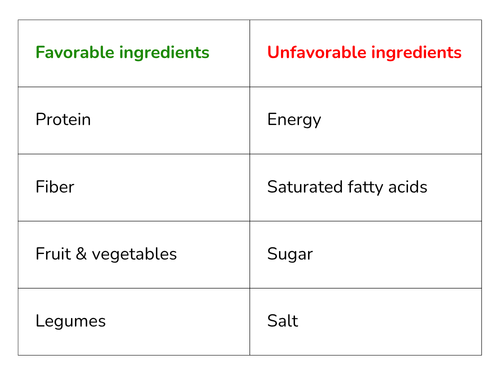
The total of the positive and negative points determines the classification into one of the Nutri-Score categories from A to E. When consumed in larger amounts, unfavorable ingredients can have a negative impact on health and increase the risk of diet-related diseases such as cardiovascular disease and diabetes mellitus.
Does the Nutri-Score also have disadvantages?
Yes. The Nutri-Score does not take the degree of processing of foods into account. If you have already browsed the Neatic website a little, you have probably come across the term “ultra-processed foods”. These have an unfavorable impact on health and promote overeating and obesity.
Since the Nutri-Score is only displayed on packaged foods, a diet based solely on the Nutri-Score can promote the selection of ultra-processed foods. A healthy diet should also always include unprocessed foods such as fruits and vegetables.
In addition, manufacturers can improve the Nutri-Score relatively easily by artificially adding ingredients that are considered beneficial for health, such as fiber or protein. However, foods fortified with fiber or protein are not automatically healthier than their corresponding products without such fortification. On the contrary: Quite often, fortification can even turn an previously unprocessed or minimally processed product into an ultra-processed food.
In addition, certain food ingredients are not taken into account when calculating the Nutri-Score, such as vitamins and minerals. However, these are essential for health and are found particularly in unprocessed foods such as fruits and vegetables.
For consumers to be able to use the Nutri-Score optimally, it is necessary for all manufacturers to indicate the Nutri-Score of their products. A look at the supermarket shows, however, that this is still far from being the case.
Information about soft drinks:
The Nutri-Score can be improved very easily by replacing sugar with sweeteners. Since this automatically reduces the sugar and energy content of the food, two unfavorable ingredients for the Nutri-Score calculation are reduced at the same time. Although revisions to the Nutri-Score have made this apparent improvement somewhat more difficult, soft drinks with sweeteners that receive a Nutri-Score C still have a significantly better rating than their sugar-sweetened counterparts, which receive a straight E. However, extensive scientific data show that both types of soft drinks are associated with overeating and obesity, meaning that the better Nutri-Score of soft drinks sweetened with sweeteners is not justified.

What does Neatic recommend about the Nutri-Score?
The Nutri-Score is an attempt to classify foods based on ingredients that are considered beneficial or unfavorable for health. One positive aspect is that the Nutri-Score is easy to understand and provides an incentive to make food formulations healthier.
Both Nutri-Score and Neatic take the sugar content of foods into account. Since the Nutri-Score does not take added flavors into account and only explicitly considers sweeteners in beverages, these ingredients can also be found in foods with a good rating. These foods would not be suitable for a Neatic-based diet since they fall under Neatic principles No. 1 and 2 and should therefore be avoided.
The biggest disadvantage of the Nutri-Score is that it does not take the degree of processing of foods adequately into account. On the contrary: Some measures used to improve the Nutri-Score, such as the artificial addition of fiber and protein and the replacement of sugar with sweeteners, can even further increase the degree of processing.
Neatic, on the other hand, takes the degree of processing of foods into account by avoiding added flavors and sweeteners and limiting sugar. Thereby, the majority of ultra-processed foods are identified.
If you want, you can in principle also pay attention to the Nutri-Score in addition to the Neatic principles. However, it is not necessary.
Another way of classifying foods is the NOVA classification. You can read here what it is about.
Bibliography
BMLEH (2026): Nutri-Score. Available online at https://www.bmleh.de/DE/themen/ernaehrung/lebensmittel-kennzeichnung/freiwillige-angaben-und-label/nutri-score/nutri-score_node.htm, checked on 9/10/2026.
Committee, Guidelines Review (2015): Guideline: sugars intake for adults and children. World Health Organization, 3/4/2015. Available online at https://www.who.int/publications/i/item/9789241549028, checked on 7/19/2024.
Committee, Guidelines Review (2023): Use of non-sugar sweeteners: WHO guideline. World Health Organization, 5/15/2023. Available online at https://www.who.int/publications/i/item/9789240073616, checked on 7/19/2024.
