
Major points:
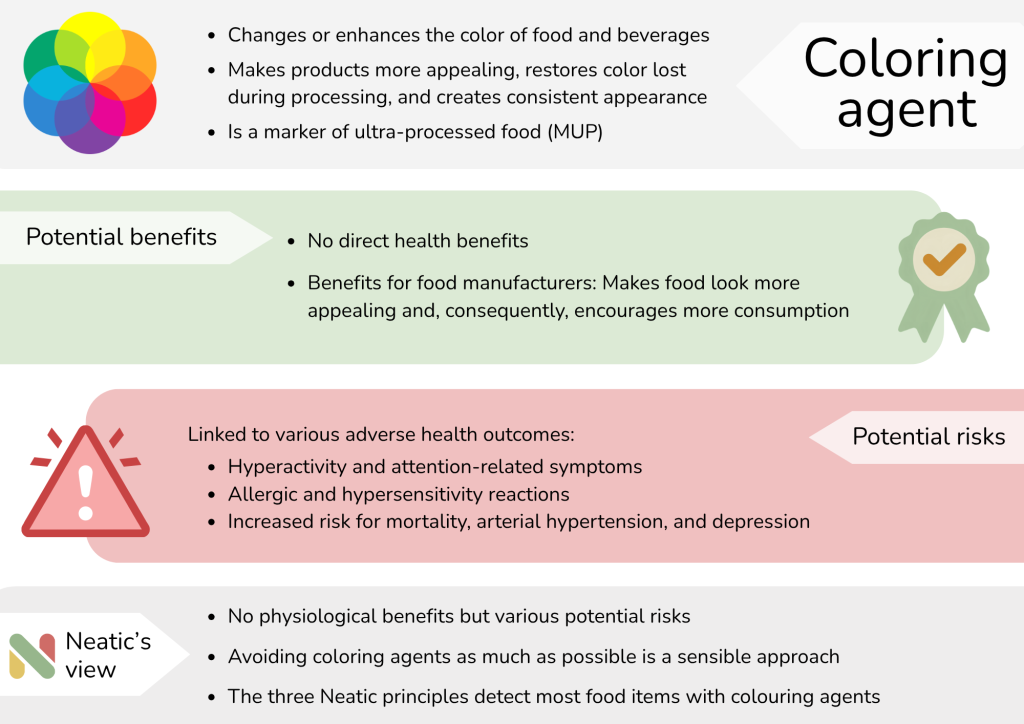
- Coloring agents, also called food dyes or food colors, are added to food to improve their appeal. For example, giving a beverage or candy a bright color makes it more attractive to consumers.
- Coloring agent is a marker of ultra-processed food (MUP) and many products with coloring agents, such as sweetened beverages also contain additional MUPs including added flavor, sweetener, and varieties of sugar.
- Coloring agents have been linked to various adverse health outcomes including hyperactivity and attention-related symptoms, allergic and hypersensitivity reactions, as well as increased risk for mortality, arterial hypertension, and depression.
What are coloring agents?
Coloring agents, also called food dyes or food colors, are additives used to change or enhance the color of food and beverages. Coloring agents are added to make products look more appealing, restore color that is lost during processing or storage, as well as create a consistent appearance that consumers expect. Coloring agents can be either synthetically made through chemical processes or naturally derived from sources such as fruits, vegetables, and spices.
What are the potential benefits of coloring agents?
Coloring agents themselves do not provide direct health benefits and do not improve the nutritional value of food.
However, coloring agents offer benefits for food manufacturers. They make food look more colorful and appealing which can encourage people to eat it. The addition of coloring agents to food can create the impression that a greater amount of raw material was used during production than was actually the case. For example, a brightly colored strawberry yogurt may suggest that a larger quantity of strawberries was used compared with a lightly colored strawberry yogurt.
What are the potential risks of coloring agents?
Hyperactivity and attention-related effects
Several coloring agents have been linked to adverse behavioral outcomes in children especially hyperactivity and attention-related symptoms. A recent systematic review by the California Office of Environmental Health Hazard Assessment confirmed that challenging children with coloring agents led to adverse behavioral outcomes in the majority of studies. In animal experiments, direct effects of several coloring agents on spontaneous motor activity, learning, and memory, as well as brain structure and local neurotransmitter levels were shown, further supporting the findings in humans.
Allergic and hypersensitivity reactions
Several coloring agents, in addition to sweeteners and flavor enhancers, have been linked to allergic and hypersensitivity reactions, including urticaria, eczema, rhinitis, and gastrointestinal symptoms. The prevalence of hypersensitivity due to food additives has been estimated to be about 1.2%. Even anaphylactic reactions have been reported for coloring agents such as tartrazine, carmine, and patent blue.
Increased risk for mortality, hypertension, and depression
In three recent prospective cohort studies with UK Biobank participants, higher intake of food items containing coloring agents was significantly and linearly associated with an increased risk of mortality, arterial hypertension, and depression. These exploratory studies cannot establish causality and, therefore, further mechanistic studies are necessary to better understand the role of coloring agents in these three outcomes.
Ultra-processed food, energy overconsumption, and obesity
According to the NOVA classification, coloring agent is a marker of ultra-processed food (MUP). Therefore, by definition, every product containing coloring agents is an ultra-processed food (UPF) item. Even worse, food items with coloring agents often contain additional MUPs such as flavor and sweetener both of which cause overeating and obesity. If the preferential consumption of UPF leads to energy intake beyond requirements, weight gain and obesity develop.
What does Neatic recommend concerning coloring agents?
Addition of coloring agents to food items does not provide any physiological benefits but has various potential risks. Therefore, avoiding coloring agents as much as possible is a sensible approach. The three Neatic principles detect more than 75% of all UPF and, therefore, also most food items with colouring agents. If food items with coloring agents are to be detected even more consistently, consumers can search ingredient lists for the signal words “color” or “dye”.
Bibliography
Blumenthal, Annika Katja; Eichner, Gerrit; Fasshauer, Mathias; Eise, Nathalie Judith (2026): Relationship between 39 dietary markers of ultra-processed food and incident depression: evidence from the prospective UK Biobank cohort study. Eur J Nutr 65 (6). DOI: 10.1007/s00394-026-04084-7.
Krost, Kathrin Marie; Eichner, Gerrit; Fasshauer, Mathias; Eise, Nathalie Judith (2025): Association of 37 markers of ultra-processing with all-cause mortality: a prospective cohort study in the UK Biobank. EClinicalMedicine 88, p. 103448. DOI: 10.1016/j.eclinm.2025.103448.
Krost, Kathrin Marie; Eichner, Gerrit; Fasshauer, Mathias; Eise, Nathalie Judith (2026): Markers of ultra-processed food and incident arterial hypertension in the UK Biobank. Eur Heart J. DOI: 10.1093/eurheartj/ehag614.
Miller, Mark D.; Steinmaus, Craig; Golub, Mari S.; Castorina, Rosemary; Thilakartne, Ruwan; Bradman, Asa; Marty, Melanie A. (2022): Potential impacts of synthetic food dyes on activity and attention in children: a review of the human and animal evidence. Environ Health 21 (1), p. 45. DOI: 10.1186/s12940-022-00849-9.
Sadighara, Parisa; Safta, Mehdi; Limam, Intissar; Ghanati, Kiandokht; Nazari, Zahra; Karami, Marzieh; Abedini, Amirhossein (2023): Association between food additives and prevalence of allergic reactions in children: a systematic review. Rev Environ Health 38 (1), pp. 181–186. DOI: 10.1515/reveh-2021-0158.
Treudler, Regina; Simon, Jan Christoph (2022): Anaphylaxis to food additives. Allergo J Int 31 (5), pp. 141–144. DOI: 10.1007/s40629-022-00203-y.