
Major points:
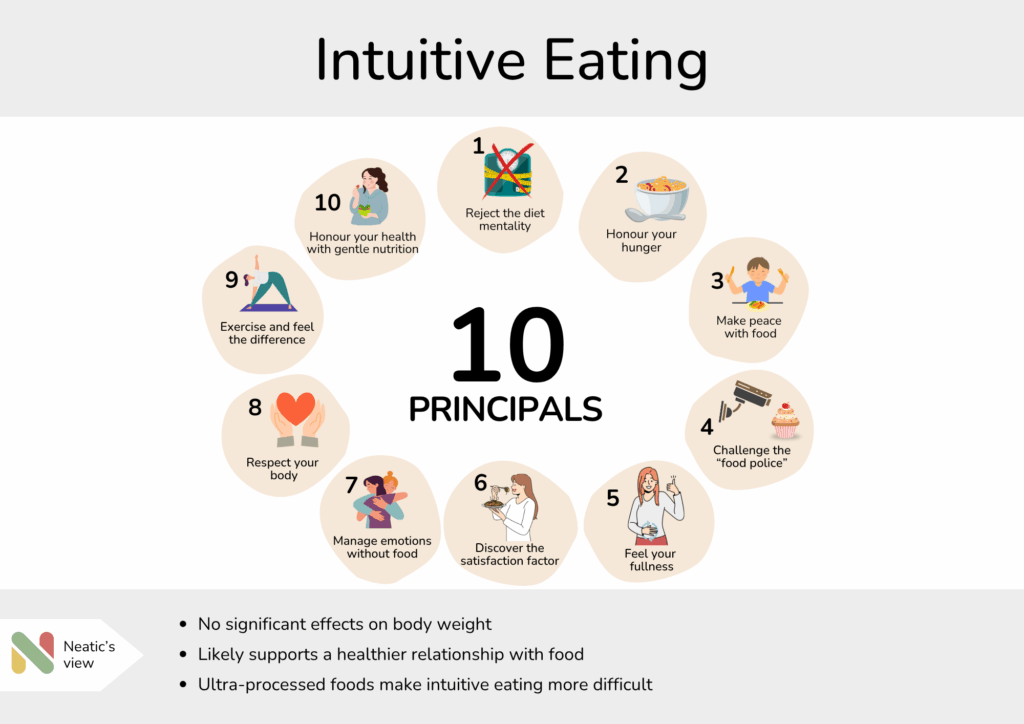
- Intuitive eating is based on 10 principles, with rejecting the diet mentality, listening to hunger and fullness signals, enjoying food, and engaging in natural daily movement being particularly important.
- Studies suggest that intuitive eating does not have significant effects on body weight but likely improves mental health and a healthy relationship with food.
- Intuitive eating is a meaningful concept; however, it does not consider that highly processed foods with added flavors, sweeteners, and sugar can trigger addictive cravings and disrupt important unconscious learning processes of the body.
What is intuitive eating?
Intuitive eating is a dietary concept that does not rely on diet rules but is based on recognizing bodily signals such as hunger and fullness. The goal is to regain trust in one’s own body to promote a healthy relationship with food and eating behaviors. This involves eating when and what you are hungry for and stopping when you are full. Intuitive eating was developed by dietitians Evelyn Tribole and Elyse Resch and was presented in initial scientific publications before the turn of the millennium.
What specific recommendations are given?
Intuitive eating is based on 10 principles designed to promote a healthy relationship with food and body image:
1. Reject the diet mentality.
Traditional diets should not be followed, as they do not promote long-term health or stable body weight. Instead, they can cause harm through the yo-yo effect and an unhealthy relationship with food.
2. Honor your hunger.
Hunger signals that the body needs food to be adequately supplied with energy and nutrients. Therefore, hunger cues are fully trusted, and eating occurs when the feeling arises.
3. Make peace with food.
The endless cycle of restriction, craving certain foods, binge eating, and guilt is broken. This includes permitting oneself to eat all types of foods without guilt or fear of weight gain.
4. Challenge the “food police.”
The inner critical voice that evokes guilt and strict eating habits is critically questioned. In particular, thoughts about “good” and “bad” foods are rejected.
5. Feel your fullness.
Fullness signals that the body is adequately supplied with energy and nutrients. Therefore, the feeling of fullness is fully trusted, and eating stops when it occurs.
6. Discover the satisfaction factor.
Eating is more than just nutrient intake. It also involves pleasure and joy, which should be rediscovered.
7. Cope with emotions with kindess.
Strategies are developed to manage negative emotions such as stress, boredom, and sadness without resorting to food for comfort.
8. Respect your body.
One’s own body is accepted and treated with respect and dignity, regardless of its shape or size. The focus is not on appearance but on its abilities.
9. Exercise and feel the difference.
Movement without enjoyment is usually not sustained long-term. Therefore, forms of exercise that are enjoyable and beneficial are chosen. The goal of movement is well-being, not calorie burning.
10. Honor your health with gentle nutrition.
The diet should align with personal taste preferences and not be based on rigid rules or guidelines. A healthy and varied diet should feel good.
Is recognizing bodily signals important only in intuitive eating?
No. In other dietary concepts, recognizing bodily signals is also of central importance. In mindful eating, conscious awareness and enjoyment of food are emphasized. It includes mindfulness practices such as slow eating and deliberate chewing, as well as consciously experiencing hunger and fullness cues. It aims to establish a closer connection to the foods consumed, combined with fully experiencing the present moment.
Both concepts, intuitive and mindful eating, thus increase awareness of hunger and fullness signals, improve self-observation, trust the body, and reject traditional diets. A difference is that in mindful eating, meditative exercises typically play a central role.

Does intuitive eating help with weight loss?
There are currently few studies on the effects of intuitive or mindful eating on body weight. In 2019, a meta-analysis was published summarizing 10 intervention studies. Across all studies, participants lost 350 g more with intuitive/mindful eating compared to control groups with no intervention. When intuitive/mindful eating was compared to other diets, it had comparable effectiveness. The analysis highlighted several issues in assessing the studies: only one study examined intuitive eating, while the other nine characterized mindful eating. All studies were of short duration: only one intervention lasted over a year, while the remaining studies ranged from 6 weeks to 6 months. Additionally, relatively few participants were studied, with the intuitive eating study being particularly small, involving only 16 people.
In 2024, a study with 1,821 randomly selected individuals assessed the extent of intuitive eating using a questionnaire. Women with a strong tendency toward intuitive eating were more likely to maintain stable body weight (±2 kg) and had a lower likelihood of weight gain (>2 kg), while this association was not observed in men. In both genders, intuitive eating was associated over time with less frequent overeating and less disordered eating behaviors. However, this study also had various limitations: it was not an intervention but merely an observation of different eating habits. All data were self-reported by participants and not independently collected by a study team. Therefore, other differences between individuals with more or less intuitive eating (e.g., age, gender, education level, income) could also influence the results.
Are there additional studies on intuitive eating?
There is evidence that intuitive eating improves mental health and a healthy relationship with food.
In 2024, a study was published in which 114 participants underwent a 3-month program based on intuitive eating. Data were collected at the beginning, after 3 months, and after 6 months. The intervention helped participants adopt a more intuitive eating behavior. This was accompanied by a reduction in eating disorder symptoms, which are behaviors or thought patterns related to eating, body weight, and body image that can lead to health problems. Additionally, internalized weight stigma, i.e., negative beliefs and self-judgments about one’s own weight and appearance influenced by societal norms and prejudices, leading to psychological stress and low self-esteem, decreased. Six months after the start of the intervention, there was also a significant reduction in the consumption of added sugar, fast food, and sugary drinks. However, weight effects of the intervention were not described.
What does Neatic recommend concerning intuitive eating?
Neatic strongly supports many practices involved in intuitive eating.
Rejecting the diet mentality, listening to hunger and fullness signals, enjoying food, and engaging in natural daily movement are also important components of Neatic.
However, in a world abundant with ultra-processed foods and fattening ingredients like added flavors, sweeteners, and sugar, it is extremely challenging to eat intuitively. These foods promote addictive cravings and disrupt important unconscious learning processes of the body.
Therefore, intuitive eating can only succeed in the long term if Neatic principles are initially considered, avoiding foods with added flavors and sweeteners, and limiting particularly sugary foods. More information about the Neatic program can be found here.
Bibliography
Fuentes Artiles, Ruben; Staub, Kaspar; Aldakak, Lafi; Eppenberger, Patrick; Rühli, Frank; Bender, Nicole (2019): Mindful eating and common diet programs lower body weight similarly: Systematic review and meta-analysis. Obes Rev 20 (11), pp. 1619–1627. DOI: 10.1111/obr.12918.
Gast, J.; Hawks, S. R. (1998): Weight loss education: the challenge of a new paradigm. Health Educ Behav 25 (4), pp. 464–473. DOI: 10.1177/109019819802500405.
Giacone, Luana; Sob, Cynthia; Siegrist, Michael; Hartmann, Christina (2024): Intuitive eating and its influence on self-reported weight and eating behaviors. Eat Behav 52, p. 101844. DOI: 10.1016/j.eatbeh.2024.101844.
Resch, Elyse; Tribole, Evelyn (2024): Intuitiv essen. Schluss mit dem Diätwahn: Genuss ohne schlechtes Gewissen – Überarbeitete Neuausgabe. Neuausgabe. München: Goldmann.
Schmid, Jane; Linxwiler, Ashley; Owen, Erica; Caplan, Heather; Jenkins, Kristi Rahrig; Bauer, Katherine W.; Zawistowski, Matthew; Weeks, Heidi M.; Sonneville, Kendrin R. (2024): Weight-inclusive, intuitive eating-based workplace wellness program associated with improvements in intuitive eating, eating disorder symptoms, internalized weight stigma, and diet quality. Eat Behav 52, p. 101840. DOI: 10.1016/j.eatbeh.2023.101840.