
Major points:
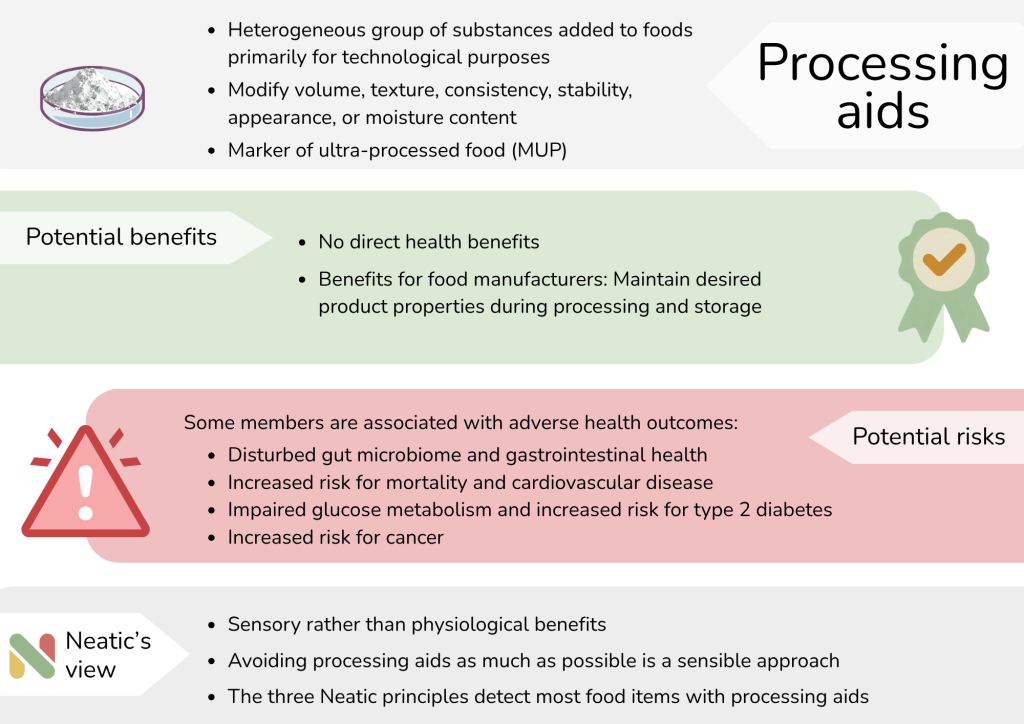
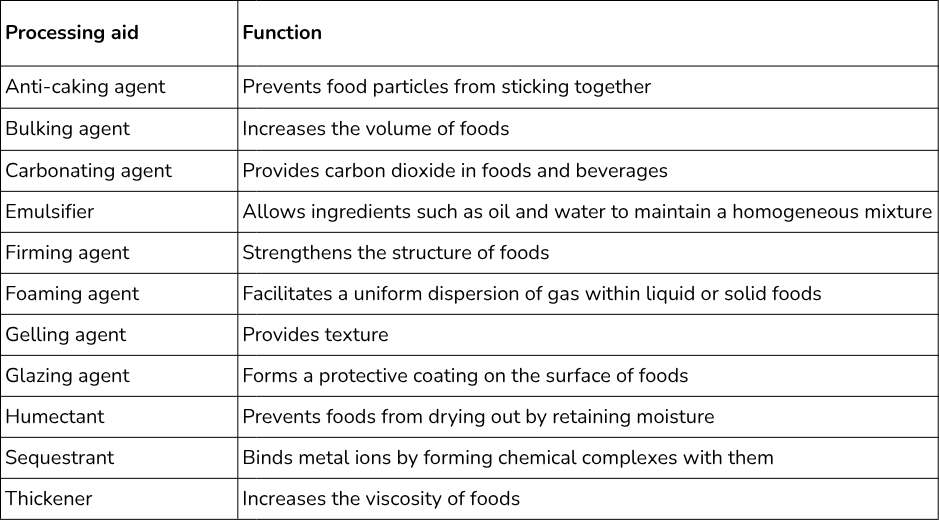
- Processing aids comprise a heterogeneous group of substances added to foods primarily for technological purposes, for example to modify volume, texture, consistency, stability, appearance, or moisture content. They include anti-caking agents, bulking agents, carbonating agents, emulsifiers, firming agents, foaming agents, gelling agents, glazing agents, humectants, sequestrants, and thickeners.
- Processing aids are markers of ultra-processed food (MUPs) and many products with processing aids also contain additional MUPs including added flavor, sweetener, and varieties of sugar.
- Human studies have raised particular concerns about some emulsifiers and thickeners. For many other processing aids, no systematic long-term studies evaluating eating behavior and cardiometabolic health have been performed.
What are processing aids?
Processing aids comprise a heterogeneous group of substances added to foods primarily for technological purposes, for example to modify volume, texture, consistency, stability, appearance, or moisture content. The different processing aids and their function are summarized in the table:
What are the potential benefits of processing aids?
Improved product characteristics
Processing aids offer benefits for food manufacturers. They can improve characteristics such as texture, consistency, stability, appearance, moisture retention, and shelf life, allowing manufacturers to maintain desired product properties during processing and storage.
What are the potential risks of processing aids?
Adverse effects on gut microbiome and gastrointestinal health
In a randomized controlled-feeding study comprising 16 healthy adults, consumption of 15 g per day of the emulsifier carboxymethylcellulose (CMC) for 11 days altered gut microbiota composition and the fecal metabolome, reduced microbiota diversity, and modestly increased postprandial abdominal discomfort. A more recent placebo-controlled randomized trial investigating five dietary emulsifiers found reduced concentrations of short-chain fatty acids but no significant effects on intestinal permeability, intestinal or systemic inflammation, or metabolic outcomes. A systematic review of human studies concluded that poorly absorbed polyols such as sorbitol and mannitol, which can be used as bulking agents and humectants, can cause gastrointestinal symptoms including abdominal pain, bloating, and diarrhea, particularly at higher doses. In a small randomized controlled trial in patients with ulcerative colitis in remission, three participants receiving the emulsifier, gelling agent, and thickener carrageenan experienced disease relapse compared with none receiving placebo.
Increased risk for mortality and cardiovascular disease
In a prospective cohort study comprising 186,744 UK Biobank participants, higher intake of food items containing the processing aids caking agent and thickener was significantly associated with an increased risk of mortality. Higher consumption of several emulsifiers was associated with an increased risk of cardiovascular disease in 95,442 participants of the French NutriNet-Santé cohort with associations observed particularly for celluloses and the emulsifiers mono- and diglycerides of fatty acids. These exploratory studies cannot establish causality and, therefore, further mechanistic studies are necessary to better understand the role of these processing aids in mortality and cardiovascular disease.
Impaired glucose metabolism and increased risk for type 2 diabetes
In a prospective study comprising 104,139 participants of the French NutriNet-Santé cohort, higher intake of several emulsifiers including carrageenans, tripotassium phosphate, sodium citrate, guar gum, gum arabic, xanthan gum, and acetyl tartaric acid esters of mono- and diglycerides of fatty acids was associated with an increased risk of type 2 diabetes. In a randomized, double-blind crossover trial comprising 20 men, the emulsifier, gelling agent, and thickener carrageenan increased intestinal permeability, while BMI-dependent analyses indicated reduced whole-body and hepatic insulin sensitivity and increased inflammatory markers in participants with higher body weight.
Increased risk for cancer
In a prospective study comprising 92,000 participants of the French NutriNet-Santé cohort, higher intake of the emulsifiers mono- and diglycerides of fatty acids was associated with increased risks of overall, breast, and prostate cancer, while higher intake of the emulsifier, gelling agent, and thickener carrageenan was associated with an increased risk of breast cancer.
Ultra-processed food, energy overconsumption, and obesity
According to the NOVA classification, processing aid is a marker of ultra-processed food (MUP). Therefore, by definition, every product containing processing aids is an ultra-processed food (UPF) item. Even worse, food items with processing aids often contain additional MUPs such as flavor and sweetener both of which cause overeating and obesity. If the preferential consumption of UPF leads to energy intake beyond requirements, weight gain and obesity develop.
Long-term effects insufficiently studied
For other processing aids, no systematic studies have been performed to evaluate the long-term effects on eating behavior and cardiometabolic health.
What does Neatic recommend concerning processing aids?
Processing aids provide sensory rather than physiological benefits. The three Neatic principles detect more than 75 % of all UPF and, therefore, also most food items with processing aids. If food items with processing aids are to be detected even more consistently, consumers can search ingredient lists for the signal words “bulking”, “caking”, “carbonating”, “chelating”, “coating”, “emulsifier”, “firming”, “foaming”, “gelling”, “glazing”, “humectant”, “leavening”, “raising”, “sequestrant”, “thickener”, and “thickening”.
Bibliography
Bhattacharyya, Sumit; Shumard, Theresa; Xie, Hui; Dodda, Amar; Varady, Krista A.; Feferman, Leo; Halline, Allan G.; Goldstein, Jay L.; Hanauer, Stephen B.; Tobacman, Joanne K. (2017): A randomized trial of the effects of the no-carrageenan diet on ulcerative colitis disease activity. Nutr Healthy Aging 4 (2), pp. 181–192. DOI: 10.3233/NHA-170023.
Chassaing, Benoit; Compher, Charlene; Bonhomme, Brittaney; Liu, Qing; Tian, Yuan; Walters, William; Nessel, Lisa; Delaroque, Clara; Hao, Fuhua; Gershuni, Victoria; Chau, Lillian; Ni, Josephine; Bewtra, Meenakshi; Albenberg, Lindsey; Bretin, Alexis; McKeever, Liam; Ley, Ruth E.; Patterson, Andrew D.; Wu, Gary D.; Gewirtz, Andrew T.; Lewis, James D. (2022): Randomized Controlled-Feeding Study of Dietary Emulsifier Carboxymethylcellulose Reveals Detrimental Impacts on the Gut Microbiota and Metabolome. Gastroenterology 162 (3), pp. 743–756. DOI: 10.1053/j.gastro.2021.11.006.
FAO/WHO Food Standards (2026): GSFA Online, Food Additive Functional Classes. Updated up to the 49th Session of the Codex Alimentarius Commission (2026). Available online at https://www.fao.org/gsfaonline/reference/techfuncs.html, checked on 9/8/2026.
Krost, Kathrin Marie; Eichner, Gerrit; Fasshauer, Mathias; Eise, Nathalie Judith (2025): Association of 37 markers of ultra-processing with all-cause mortality: a prospective cohort study in the UK Biobank. EClinicalMedicine 88, p. 103448. DOI: 10.1016/j.eclinm.2025.103448.
Lenhart, Adrienne; Chey, William D. (2017): A Systematic Review of the Effects of Polyols on Gastrointestinal Health and Irritable Bowel Syndrome. Adv Nutr 8 (4), pp. 587–596. DOI: 10.3945/an.117.015560.
Salame, Clara; Javaux, Guillaume; Sellem, Laury; Viennois, Emilie; Edelenyi, Fabien Szabo de; Agaësse, Cédric; Sa, Alexandre de; Huybrechts, Inge; Pierre, Fabrice; Coumoul, Xavier; Julia, Chantal; Kesse-Guyot, Emmanuelle; Allès, Benjamin; Fezeu, Léopold K.; Hercberg, Serge; Deschasaux-Tanguy, Mélanie; Cosson, Emmanuel; Tatulashvili, Sopio; Chassaing, Benoit; Srour, Bernard; Touvier, Mathilde (2024): Food additive emulsifiers and the risk of type 2 diabetes: analysis of data from the NutriNet-Santé prospective cohort study. Lancet Diabetes Endocrinol 12 (5), pp. 339–349. DOI: 10.1016/S2213-8587(24)00086-X.
Sellem, Laury; Srour, Bernard; Javaux, Guillaume; Chazelas, Eloi; Chassaing, Benoit; Viennois, Emilie; Debras, Charlotte; Druesne-Pecollo, Nathalie; Esseddik, Younes; Szabo de Edelenyi, Fabien; Arnault, Nathalie; Agaësse, Cédric; Sa, Alexandre de; Lutchia, Rebecca; Huybrechts, Inge; Scalbert, Augustin; Pierre, Fabrice; Coumoul, Xavier; Julia, Chantal; Kesse-Guyot, Emmanuelle; Allès, Benjamin; Galan, Pilar; Hercberg, Serge; Deschasaux-Tanguy, Mélanie; Touvier, Mathilde (2024): Food additive emulsifiers and cancer risk: Results from the French prospective NutriNet-Santé cohort. PLoS Med 21 (2), e1004338. DOI: 10.1371/journal.pmed.1004338.
Sellem, Laury; Srour, Bernard; Javaux, Guillaume; Chazelas, Eloi; Chassaing, Benoit; Viennois, Emilie; Debras, Charlotte; Salamé, Clara; Druesne-Pecollo, Nathalie; Esseddik, Younes; Edelenyi, Fabien Szabo de; Agaësse, Cédric; Sa, Alexandre de; Lutchia, Rebecca; Louveau, Erwan; Huybrechts, Inge; Pierre, Fabrice; Coumoul, Xavier; Fezeu, Léopold K.; Julia, Chantal; Kesse-Guyot, Emmanuelle; Allès, Benjamin; Galan, Pilar; Hercberg, Serge; Deschasaux-Tanguy, Mélanie; Touvier, Mathilde (2023): Food additive emulsifiers and risk of cardiovascular disease in the NutriNet-Santé cohort: prospective cohort study. BMJ 382, e076058. DOI: 10.1136/bmj-2023-076058.
Wagner, Robert; Buettner, Janine; Heni, Martin; Fritsche, Louise; Kullmann, Stephanie; Wagmüller, Moritz; Peter, Andreas; Preissl, Hubert; Machann, Jürgen; Jumpertz von Schwartzenberg, Reiner; Birkenfeld, Andreas L.; Pape, Ulrich-Frank; van Hall, Gerrit; Plomgaard, Peter; Häring, Hans-Ulrich; Fritsche, Andreas; Thompson, Kelsey N.; Klein, Reinhild; Stefan, Norbert (2024): Carrageenan and insulin resistance in humans: a randomised double-blind cross-over trial. BMC Med 22 (1), p. 558. DOI: 10.1186/s12916-024-03771-8.
Wellens, Judith; Vanderstappen, Julie; Hoekx, Sien; Vissers, Eva; Luppens, Martijn; van Elst, Lies; Lenfant, Matthias; Raes, Jeroen; Derrien, Muriel; Verstockt, Bram; Ferrante, Marc; Verbeke, Kristin; Matthys, Christophe; Vermeire, Séverine; Sabino, João (2026): Effect of Five Dietary Emulsifiers on Inflammation, Permeability, and the Gut Microbiome: A Placebo-controlled Randomized Trial. Clin Gastroenterol Hepatol 24 (4), pp. 1092–1101. DOI: 10.1016/j.cgh.2025.08.005.