
Major points:
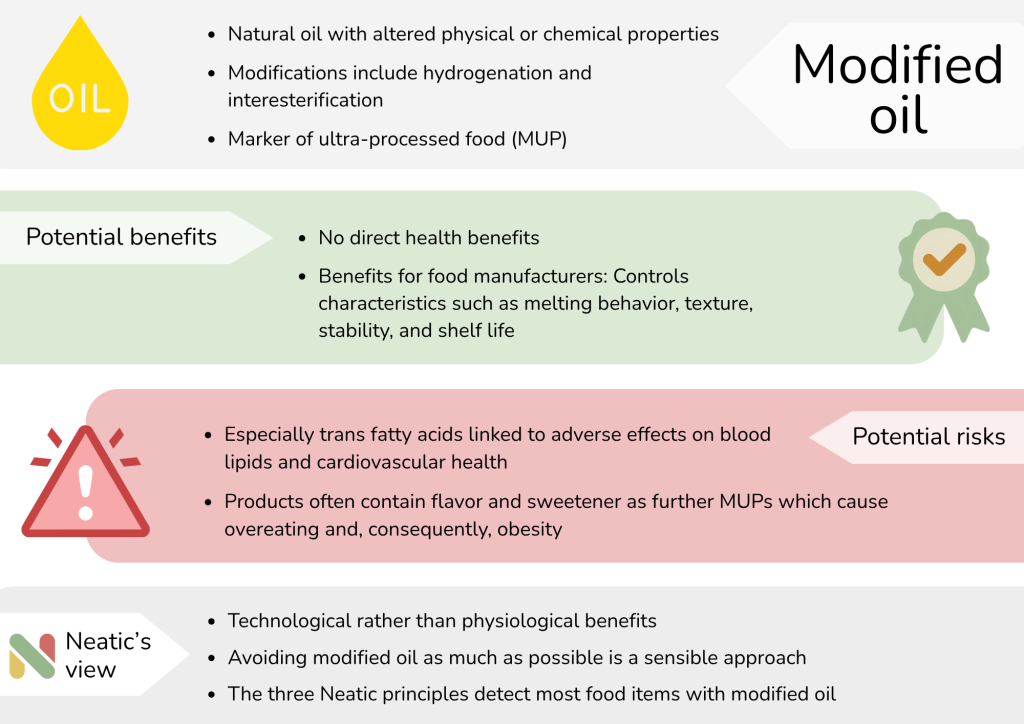
- Modified oil is a natural oil that has been treated to change its physical or chemical properties. Common modifications include hydrogenation and interesterification which allow manufacturers to control characteristics such as melting behavior, texture, stability, and shelf life.
- Modified oil is a marker of ultra-processed food (MUP) and many products with modified oil also contain additional MUPs including added flavor, sweetener, and varieties of sugar.
- Partially hydrogenated oils contain industrial trans fatty acids which have adverse effects on blood lipids and cardiovascular health. No systematic studies have been performed to evaluate other modification processes such as interesterification on eating behaviour and cardiometabolic health.
What is modified oil?
Modified oil is a natural oil that has been treated to change its physical or chemical properties. Common modification processes include hydrogenation and interesterification. These modifications allow manufacturers to control characteristics such as melting behavior, texture, stability, and shelf life.
What are the potential benefits of modified oil?
Improved product characteristics
Modified oil offers benefits for food manufacturers. Modification can change the melting behavior, texture, stability, and shelf life of natural oils. For example, partial hydrogenation was used for decades to convert liquid vegetable oils into more solid fats by increasing their degree of saturation, making them suitable for use in spreads, baked goods, and confectionery.
What are the potential risks of modified oil?
Adverse effects on blood lipids and cardiovascular health
If modified oil is produced by partial hydrogenation, so-called trans fatty acids are generated. These are unsaturated fatty acids in which the configuration around the double bond differs from the naturally predominant cis configuration. These industrial trans fatty acids have adverse effects on blood lipids, including increasing “bad” low-density lipoprotein (LDL) cholesterol and decreasing “good” high-density lipoprotein (HDL) cholesterol. Higher consumption of trans fatty acids has been convincingly linked to an increased risk of coronary heart disease.
Based on these findings, regulatory authorities substantially restricted the use of industrial trans fatty acids in recent years. In 2015, the U.S. Food and Drug Administration determined that partially hydrogenated oils were no longer “Generally Recognized as Safe” with manufacturers required to discontinue their use for most applications by June 2018. In 2019, the European Union introduced a limit of 2 g of industrial trans fatty acids per 100 g of fat in foods intended for consumers which became applicable in April 2021.
As a result, interesterification has increasingly replaced partial hydrogenation because it can provide similar technological properties of modified oils without producing large amounts of trans fatty acids. However, no systematic studies have been performed to evaluate the long-term effects of interesterification-derived modified oil on eating behavior and cardiometabolic health. Accordingly, a 2016 review concluded that “outstanding questions must be answered regarding the effects of interesterification on modifying certain aspects of lipid and glucose metabolism, inflammatory responses, hemostatic parameters, and satiety”.
Ultra-processed food, energy overconsumption, and obesity
According to the NOVA classification, modified oil is a marker of ultra-processed food (MUP). Therefore, by definition, every product containing modified oil is an ultra-processed food (UPF) item. Even worse, food items with modified oil often contain additional MUPs such as flavor and sweetener both of which cause overeating and obesity. If the preferential consumption of UPF leads to energy intake beyond requirements, weight gain and obesity develop.
What does Neatic recommend concerning modified oil?
Modified oil provides technological rather than physiological benefits. The three Neatic principles detect more than 75% of all UPF and, therefore, also most food items with modified oil. If food items with modified oil are to be detected even more consistently, consumers can search ingredient lists for the signal words “hydrogenated” or “interesterified”.
Bibliography
European Commission: Trans fat in food. Available online at https://food.ec.europa.eu/food-safety/labelling-and-nutrition/trans-fat-food_en, checked on 9/8/2026.
Grompone, M. A. (1992): Properties of vegetable oils modified by hydrogenation, interesterification and fractionation. Grasas aceites 43 (6), pp. 330–335. DOI: 10.3989/gya.1992.v43.i6.1128.
Mensink, Ronald P.; Sanders, Thomas A.; Baer, David J.; Hayes, K. C.; Howles, Philip N.; Marangoni, Alejandro (2016): The Increasing Use of Interesterified Lipids in the Food Supply and Their Effects on Health Parameters. Adv Nutr 7 (4), pp. 719–729. DOI: 10.3945/an.115.009662.
Mozaffarian, Dariush; Katan, Martijn B.; Ascherio, Alberto; Stampfer, Meir J.; Willett, Walter C. (2006): Trans fatty acids and cardiovascular disease. N Engl J Med 354 (15), pp. 1601–1613. DOI: 10.1056/NEJMra054035.
U.S. Food and Drug Administration (2024): Trans Fat. Available online at https://www.fda.gov/food/food-additives-petitions/trans-fat, checked on 9/8/2026.