
Major points:
- The scientifc study by the Neatic team compared 282 plant-based meat products with 149 corresponding meat-based products.
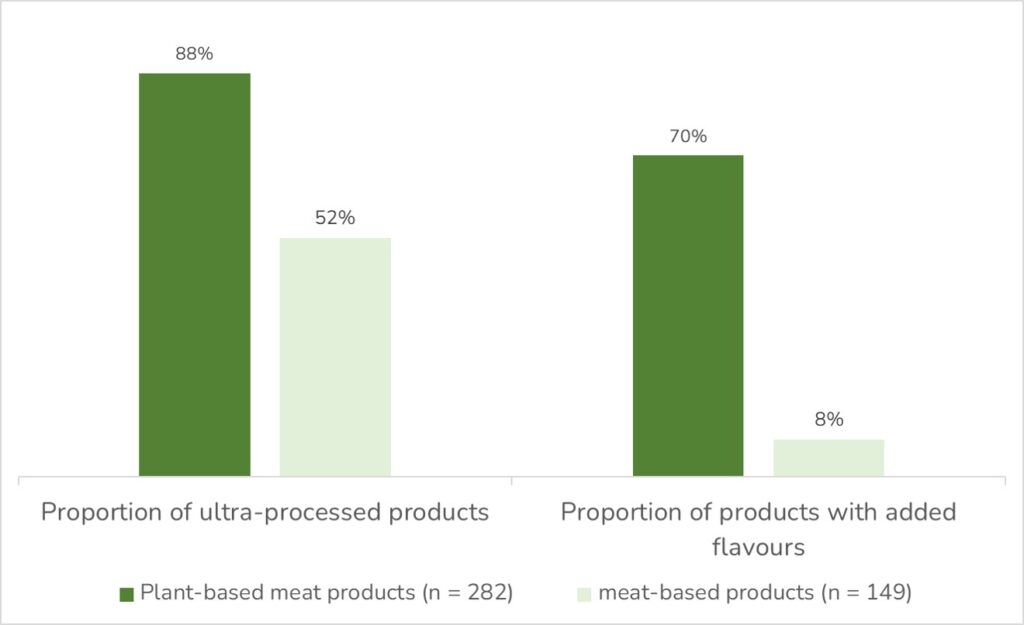
- Plant-based meat products were more frequently ultra-processed compared to meat-based products (88% versus 52%) but exhibited a slightly better nutrient composition.
- Added flavors were present in 70% of all plant-based meat products, making them the most common marker for ultra-processing.
What are plant-based meat products?
Plant-based meat products mimic meat in texture, taste, and appearance without being made from it. They can replace meat in the diet and are commonly based on ingredients like pea or soy protein.
In recent years, the number of people adopting vegetarian or vegan diets has increased. This growing interest has led to a higher demand for plant-based meat products.
What did the study investigate?
Previous studies have shown that plant-based meat products often have a better nutrient composition compared to meat-based products. Beyond nutrient composition, the degree of processing is also a crucial parameter for assessing food quality.
The study of the Neatic team examined the processing levels of plant-based meat products compared to meat-based products.
For the analysis, a total of 282 plant-based meat products and 149 corresponding meat-based products were examined. The food items were sourced from German supermarkets and discount stores such as Edeka, Rewe, Lidl, and Aldi, supplemented by online research from Bofrost, Rewe, and other plant-based meat product companies.
Based on the NOVA classification, 33 markers for ultra-processed foods (MUPs; markers of ultra-processing) were defined. MUPs are ingredients in foods that indicate a product is ultra-processed.
The ingredient lists of the foods were then analyzed for the presence of various MUPs.
What did the study find?
Plant-based meat products had a significantly higher proportion of ultra-processed foods than the meat-based products group, i.e., 88% versus 52%.
Of the 33 MUPs, 23 were present in at least one of the products. Eighteen of these MUPs were more frequently found in plant-based meat products. Added flavors were present in 70% of plant-based meat products but in only 8% of meat-based products, making added flavors the most common MUP in plant-based meat products. In meat-based products, dextrose was the most common MUP, found in 41% of products.
Regarding nutrient composition, energy content, total fat, saturated fatty acids, and protein content were significantly lower in plant-based meat products compared to meat-based products. In contrast, carbohydrate, sugar, fiber, and salt contents were significantly higher in plant-based meat products.
What does Neatic recommend concerning plant-based meat products?
The study shows that MUPs are significantly more prevalent in plant-based meat products than in meat-based products, making meat alternatives more frequently ultra-processed than traditional meat products. Only about a third of plant-based meat products are free from added flavors and can be consumed without restriction in Neatic. In our recipes, you will find a vegan, added flavor-free minced meat alternative, as well as vegan burger patties.
Bibliography
Alessandrini, Roberta; Brown, Mhairi K.; Pombo-Rodrigues, Sonia; Bhageerutty, Sheena; He, Feng J.; MacGregor, Graham A. (2021): Nutritional Quality of Plant-Based Meat Products Available in the UK: A Cross-Sectional Survey. Nutrients 13, p. 4225. DOI: 10.3390/nu13124225.
Bundesministerium für Ernährung und Landwirtschaft (2018): [Guidelines for vegan and vegetarian foods with similarities to foods of animal origin, Original in German]. Available online at https://www.bmel.de/SharedDocs/Downloads/DE/_Ernaehrung/Lebensmittel-Kennzeichnung/LeitsaetzevegetrarischeveganeLebensmittel.html, checked on 7/19/2023.
Cole, Elizabeth; Goeler-Slough, Natalie; Cox, Allison; Nolden, Alissa (2022): Examination of the nutritional composition of alternative beef burgers available in the United States. Int J Food Sci Nutr 73 (4), pp. 425–432. DOI: 10.1080/09637486.2021.2010035.
Curtain, Felicity; Grafenauer, Sara (2019): Plant-Based Meat Substitutes in the Flexitarian Age: An Audit of Products on Supermarket Shelves. Nutrients 11, p. 2603. DOI: 10.3390/nu11112603.
De Marchi, Massimo; Costa, Angela; Pozza, Marta; Goi, Arianna; Manuelian, Carmen L. (2021): Detailed characterization of plant-based burgers. Sci Rep 11 (1), p. 2049. DOI: 10.1038/s41598-021-81684-9.
Huber J; Keller M. (2017): [Nutritional and physiological evaluation of conventionally and organically produced vegetarian and vegan meat and sausage alternatives. Study commissioned by the Albert Schweitzer Foundation for Our Environment, Berlin; Original in German]. Available online at https://files.albert-schweitzer-stiftung.de/1/fleischalternativenstudie_170320.pdf, checked on 7/19/2023.
McClements, David Julian; Grossmann, Lutz (2021): The science of plant-based foods: Constructing next-generation meat, fish, milk, and egg analogs. Compr Rev Food Sci Food Saf 20 (4), pp. 4049–4100. DOI: 10.1111/1541-4337.12771.
Monteiro, Carlos A.; Cannon, Geoffrey; Levy, Renata B.; Moubarac, Jean-Claude; Louzada, Maria Lc; Rauber, Fernanda; Khandpur, Neha; Cediel, Gustavo; Neri, Daniela; Martinez-Steele, Euridice; Baraldi, Larissa G.; Jaime, Patricia C. (2019): Ultra-processed foods: what they are and how to identify them. Public Health Nutr 22 (5), pp. 936–941. DOI: 10.1017/S1368980018003762.
Monteiro, Carlos Augusto; Cannon, Geoffrey; Moubarac, Jean-Claude; Levy, Renata Bertazzi; Louzada, Maria Laura C.; Jaime, Patrícia Constante (2017): The UN Decade of Nutrition, the NOVA food classification and the trouble with ultra-processing. Public Health Nutr 21 (1), pp. 5–17. DOI: 10.1017/S1368980017000234.
Patelakis, Eleni; Lage Barbosa, Clarissa; Haftenberger, Marjolein; Brettschneider, Anna-Kristin (2019): Prevalence of vegetarian diet among children and adolescents in Germany. Ernahrungs Umschau 66 (5), pp. 85–91. DOI: 10.4455/eu.2019.018.
Romão, Bernardo; Botelho, Raquel Braz Assunção; Nakano, Eduardo Yoshio; Raposo, António; Han, Heesup; Vega-Muñoz, Alejandro; Ariza-Montes, Antonio; Zandonadi, Renata Puppin (2022): Are Vegan Alternatives to Meat Products Healthy? A Study on Nutrients and Main Ingredients of Products Commercialized in Brazil. Front Public Health 10, p. 900598. DOI: 10.3389/fpubh.2022.900598.
Tonheim, Live Edvardsen; Austad, Elisabeth; Torheim, Liv Elin; Henjum, Sigrun (2022): Plant-based meat and dairy substitutes on the Norwegian market: comparing macronutrient content in substitutes with equivalent meat and dairy products. J Nutr Sci 11, e9. DOI: 10.1017/jns.2022.6.