
Major points:
- People follow a gluten-free diet not only because they have a gluten-related disease but also to improve digestive problems, achieve health benefits, or simply because it is a current trend and lifestyle.
- People with celiac disease must strictly avoid gluten. People with other gluten-related diseases often have more flexibility due to individual tolerance levels.
- Without a medical reason, Neatic does not recommend a gluten-free diet.
More and more people today are choosing to avoid foods that contain gluten. Some follow a gluten-free diet out of personal preference, while others hope for health benefits. People with certain medical conditions have to avoid gluten completely or restrict it significantly for life.
What is gluten?
Gluten is a protein found in grains such as spelt, barley, rye, wheat, and the ancient wheat varieties einkorn, emmer, and kamut. It gives dough elasticity and ensures that baked goods retain their shape and structure. Gluten acts as a binder for liquids and holds ingredients together in the dough. It is used not only in obvious grain products such as bread or pastries but is also found in many processed foods. Some examples include sauces, dressings, ready meals, sausages, sweets, and dairy products.
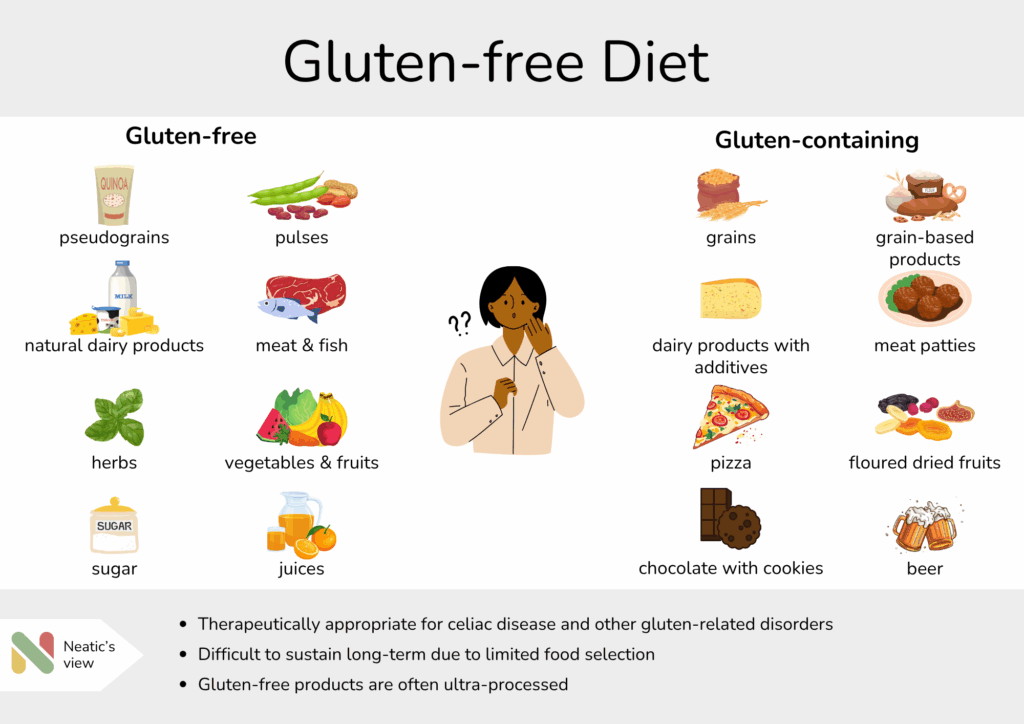
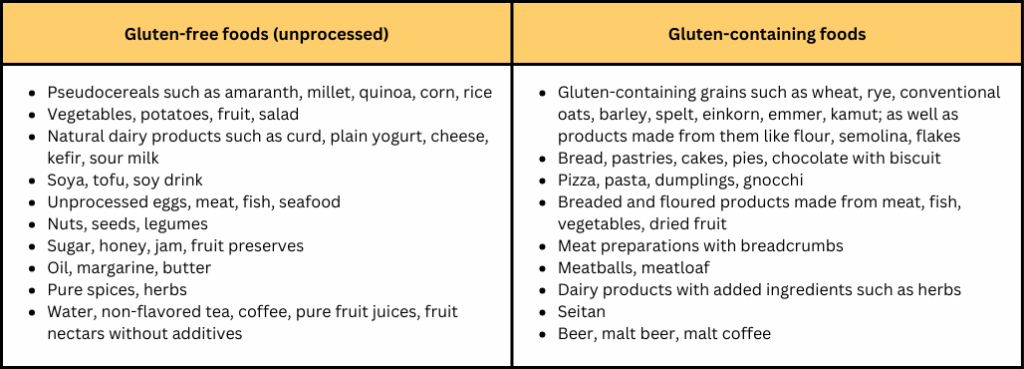
Examples for gluten-free and gluten-containing foods
Gluten-free diet
A gluten-free diet avoids all foods that contain gluten. People follow a gluten-free diet for various reasons:
- Gluten-related diseases: These include celiac disease, wheat allergy, grain allergy, wheat-dependent exercise-induced anaphylaxis and non-celiac wheat sensitivity.
- Digestive problems and health benefits: A gluten-free diet is supposed to improve digestive complaints such as diarrhea or bloating. It is also said to have health-promoting effects, such as counteracting extreme tiredness after eating, protecting coronary arteries, and helping with weight loss.
- Trend and lifestyle: Some people believe that a gluten-free diet is generally healthier and contributes to better overall well-being. The role model function of celebrities and the increased availability of gluten-free products also support this trend.
Gluten-related diseases
-
Celiac disease (also called gluten-sensitive enteropathy or coeliac sprue) is a chronic disease that can affect the intestine, as well as various organ systems. About 1 percent of people in Germany are affected, with a high number of unreported cases as many have no or very unspecific symptoms. Celiac disease is not an allergy or intolerance but a lifelong immune reaction of the body to gluten or the subfraction gliadin. If gluten is completely avoided, symptoms disappear. Celiac disease is usually diagnosed in childhood but can occur at any age. Only about 10 to 20 percent of those affected have classic symptoms such as failure to thrive with stagnation or even loss of weight in infants and children, loss of appetite, vomiting, anemia, and diarrhea. About 80 to 90 percent have atypical, few, or no symptoms and, therefore, do not know they have the disease. Thus, celiac disease can remain undetected for many years. The older the affected individuals are, the more often they show atypical symptoms. The disease can also present with a single symptom such as unexplained iron deficiency.
-
In wheat allergy, there is a hypersensitivity reaction to various wheat proteins, including gluten.
-
In grain allergy, reactions can also be triggered by other grains such as rye. The grain allergens are mainly located under the seed coat of the grains. The tolerance of grain varieties can thus be improved by consuming products with a higher extraction rate.
-
Wheat-dependent exercise-induced anaphylaxis (WDEIA) is a condition in which affected individuals develop a severe allergic reaction – anaphylaxis – after consuming wheat products in combination with physical exertion. In addition to exercise, other factors such as taking painkillers, simultaneous alcohol consumption, or hormonal influences can play a role.
-
Non-celiac wheat sensitivity (NCWS) is another form of grain intolerance. People with this condition experience gastrointestinal complaints after consuming wheat components or gluten-containing grains that are very similar to the symptoms of celiac disease. However, unlike celiac disease, there is no damage to the intestines in these individuals.
Gluten-free diet in celiac disease and other gluten-related diseases
People with celiac disease must avoid gluten. They cannot make exceptions. Even the smallest amounts of gluten lead to direct damage to the intestines and can cause long-term health problems. People with other gluten-related diseases such as wheat allergy or non-celiac wheat sensitivity usually have more flexibility in their diet. For example, people with wheat allergy can often tolerate other grains such as rye or barley and have a tolerance of up to several grams of wheat. Smaller exceptions can, therefore, usually be made without serious consequences. However, this can vary greatly from person to person.
Gluten-free diet for other reasons
But what about people who do not have a gluten-related disease but avoid gluten to improve digestive problems, achieve health benefits or simply because it is a current trend and lifestyle? There is no convincing data that a gluten-free diet is medically useful in such cases. Two studies by the Neatic team found no association between gluten intake and metabolic diseases or mortality risk. In addition, avoiding gluten also has disadvantages that must be considered. A gluten-free diet can lead to nutrient deficiencies such as a lack of vitamin D, vitamin B12, and folic acid. Gluten-free processed products made from starch or refined flour often contain less fiber and fewer minerals such as magnesium, zinc, calcium, and iron. They also often contain more sugar and saturated fats. Furthermore, gluten-free products are usually more expensive than gluten-containing products, leading to higher living costs. Eating out while traveling, in restaurants, or even with friends or at social events is often a major challenge. From a nutritional standpoint, if there is no gluten-related disease, there is no reason to avoid gluten-containing products.
If celiac disease is not present but complaints occur after consuming gluten-containing foods, it is worthwhile to look at the current food choices. A diet with many processed and white flour products usually also contains significantly more gluten. Often, small changes such as switching to whole grain products and reducing processed foods as well as increasing fresh, natural foods can alleviate symptoms.
What does Neatic recommend concerning a gluten-free diet?
Gluten-free foods are not automatically healthier or unhealthier. Natural foods such as fruits, vegetables, or rice, which are eaten in a gluten-free diet, are also allowed without restriction in Neatic. However, many gluten-free substitute products are ultra-processed and can contain added flavors. While bread and rolls are rarely flavored, pastries, and sweets more often contain added flavors. It is therefore always worth checking the ingredient list. Without a medical reason, a gluten-free diet is not recommended, as health benefits are not scientifically proven.
Bibliography
Behrendt, Inken; Fasshauer, Mathias; Eichner, Gerrit (2021): Gluten Intake and All-Cause and Cause-Specific Mortality: Prospective Findings from the UK Biobank. J Nutr 151 (3), pp. 591–597. DOI: 10.1093/jn/nxaa387.
Behrendt, Inken; Fasshauer, Mathias; Eichner, Gerrit (2021): Gluten intake and metabolic health: conflicting findings from the UK Biobank. Eur J Nutr. 60 (3), pp. 1547–1559. DOI: 10.1007/s00394-020-02351-9.
Claudia Kugler, Christiane Schäfer: WDEIA im neuen Kleid?! Cofaktorabhängige Weizenallergie. Ernahrungs Umschau 2024 (Sonderheft 9), pp. 42–48.
Hirschmann U, Bauer V.: Ernährungstherapie bei Zöliakie. Ernahrungs Umschau 2024 (Sonderheft 9), pp. 34–41.
Hübener, Sina; Manthey, Carolin Friederike (2019): Zöliakie und Weizensensitivität im Wandel – ein Update. Gastroenterologie up2date 15 (04), pp. 375–393. DOI: 10.1055/a-0862-8207.
Imke Reese: Nicht-Zöliakie-Gluten-Sensitivität (NCGS). Sachstand der Debatte. Ernahrungs Umschau 2024 (Sonderheft 9), pp. 50–51.
Melanie Braukmann: Essen und Trinken bei Zöliakie. 11th ed. Bonn: Deutsche Gesellschaft für Ernährung e. V.
Niland, Benjamin; Cash, Brooks D. (2018): Health Benefits and Adverse Effects of a Gluten-Free Diet in Non-Celiac Disease Patients. Gastroenterol Hepatol 14 (2), pp. 82–91.
Was ist Zöliakie? | DZG Online (2024). Available online at https://www.dzg-online.de/was-ist-zoeliakie, updated on 10/15/2024, checked on 10/15/2024.
Zopf, Yurdagül; Schink, Monic; Dieterich, Walburga (2017): Zöliakie, Getreideallergie, Weizensensitivität: Glutenfreie Ernährungstherapie. Aktuel Ernahrungsmed 42 (06), pp. 474–490. DOI: 10.1055/s-0043-115208.