
last revised: 08.10.2026
Major points:
- Fats belong to the macronutrients and are classified according to their origin, degree of saturation, and chain length of the fatty acids.
- Fats are the most important flavor carriers, serve as energy stores, and have more than twice as much energy as the same amount of carbohydrates or protein.
- All fats and oils can be used without restrictions in Neatic as long as they are not flavored.
What is fat?
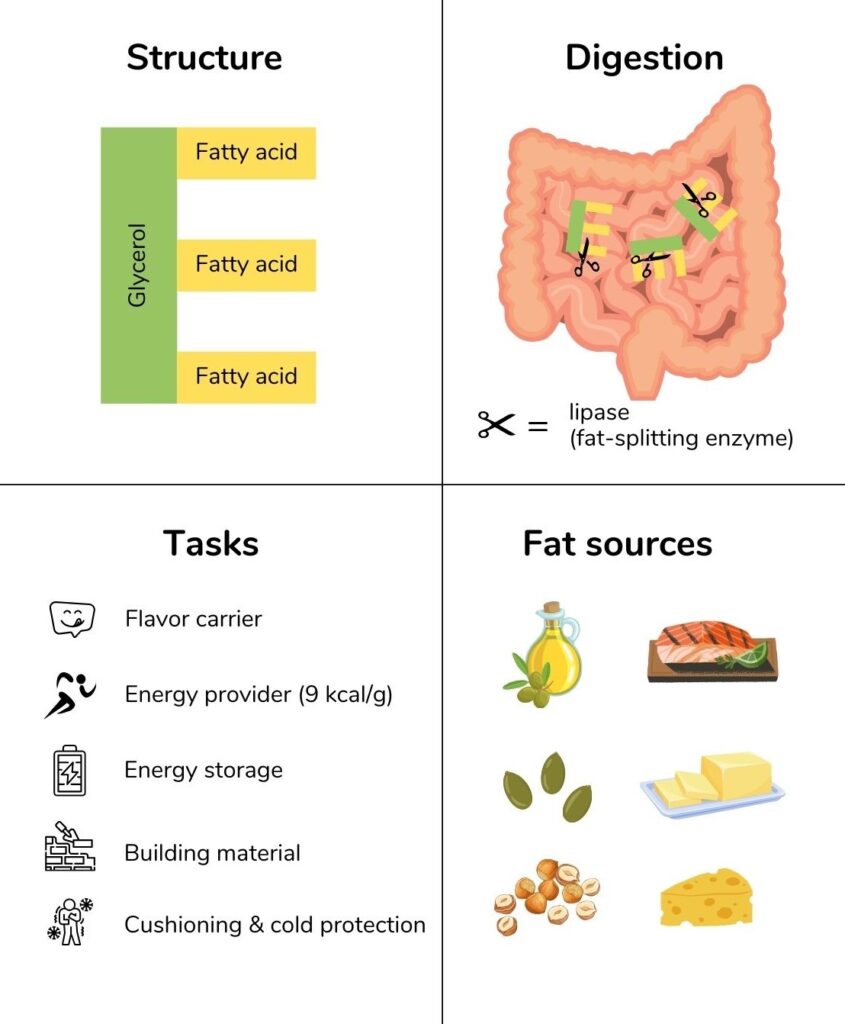
Fats (so-called triglycerides) consist of fatty acids and glycerol. They are classified according to different criteria.
According to origin
- Animal (e.g. butter and lard)
- Vegetable (e.g. margarine and all types of oil)
By degree of saturation of the fatty acids
- Monounsaturated fatty acids (e.g. in olive, canola, and sesame oil)
- Polyunsaturated fatty acids
- Omega-3 fatty acids (e.g. in fatty fish but also flax and chia seeds and oils made from them)
- Omega-6 fatty acids (e.g. in sunflower, pumpkin seed, and safflower oil)
- Saturated fatty acids (mainly in animal foods, but also in palm and coconut oil)
According to chain length of fatty acids
- Short-chain fatty acids
- Medium-chain fatty acids
- Long-chain fatty acids
Of the different fatty acids, two are essential: the omega-6 fatty acid linoleic acid and the omega-3 fatty acid α-linolenic acid. This means that the body cannot produce these two fatty acids itself. Therefore, they must be ingested through food. Other fatty acids can be produced by the body of a healthy person.
Fat digestion - how are fats broken down?
During digestion, the fat digestion mainly takes place in the small intestine with the help of bile acids from the liver and the enzyme lipase from the pancreas. The bile acids emulsify fats which means that they break them down into small droplets so that the lipase can break down the fatty acids. The split fatty acids can then be absorbed by the intestinal wall.
Fats have very different tasks
- They are the most important flavor carriers
- They provide more than twice as much energy as the same amount of carbohydrates or proteins
- They support intake of the fat-soluble vitamins A, D, E, and K into the body
- They provide the essential omega-3 and omega-6 fatty acids
- They serve as energy stores for longer periods of hunger
- They are building material for the body cells, especially for the cell walls
- They protect as adipose tissue against cold and cushion the organs
Hidden Fats
Some fats and oils can be spotted at first glance, such as the butter on a bread roll or the oil in a salad dressing. However, there are also hidden fats that are not visible at first glance. These are usually found in ultra-processed foods such as sausages, potato crisps, pastries, sweets, ready meals, and breaded or deep-fried foods. Lower-quality fats such as sunflower, coconut, or palm oil are often used in their production because they are inexpensive.
How much fat do you need?
According to the German Nutrition Society (DGE), adults aged 19 and older should consume 30% of energy intake in the form of fat. For the essential omega-6 fatty acid linoleic acid, the recommended intake is 2.5% of energy (roughly 5 g per day at an energy intake of 2,000 kcal). For the essential omega-3 fatty acid α-linolenic acid, the estimated intake value is 0.5% of energy (roughly 1 g per day at an energy intake of 2,000 kcal). The DGE recommends fatty fish, as well as plant foods including whole-grain products, vegetables, nuts, and legumes, as sources of dietary fat.
The German National Nutrition Survey II (2008) found that average fat intake was above the recommended level accounting for approximately 35% of total energy intake in women and 36% in men.
What does Neatic recommend concerning fat?
All fats and oils can be used without restrictions in Neatic as long as they are not flavored. Oils can be flavored, e.g. with truffle, lemon, and rosemary flavor. Margarine and spreadable butter can also contain added flavors. Ultra-processed foods with hidden fats are often flavored. It is worth taking a look at the ingredient list.
There are diets in which fat intake is limited. Find out here what science says about such low fat diets.
Bibliography
Deutsche Gesellschaft für Ernährung e. V. (2000): Fett, essenzielle Fettsäuren. Available online at https://www.dge.de/wissenschaft/referenzwerte/fett-essenzielle-fettsaeuren/, checked on 9/8/2026.
Höfler, Elisabeth; Sprengart, Petra (2018): Praktische Diätetik. Grundlagen, Ziele und Umsetzung der Ernährungstherapie. 2., überarbeitete und erweiterte Auflage. Stuttgart: WVG, Wissenschaftliche Verlagsgesellschaft.
Horn, Florian (2021): Biochemie des Menschen. Das Lehrbuch für das Medizinstudium. 8., überarbeitete und erweiterte Auflage. Stuttgart, New York: Thieme.
Max Rubner-Institut Bundesforschungsinstitut für Ernährung und Lebensmittel (2008): Ergebnisbericht, Teil 2 Nationale Verzehrsstudie II. Die bundesweite Befragung zur Ernährung von Jugendlichen und Erwachsenen. Available online at https://www.mri.bund.de/fileadmin/MRI/Institute/EV/NVSII_Abschlussbericht_Teil_2.pdf, checked on 9/8/2026.