
Major points:
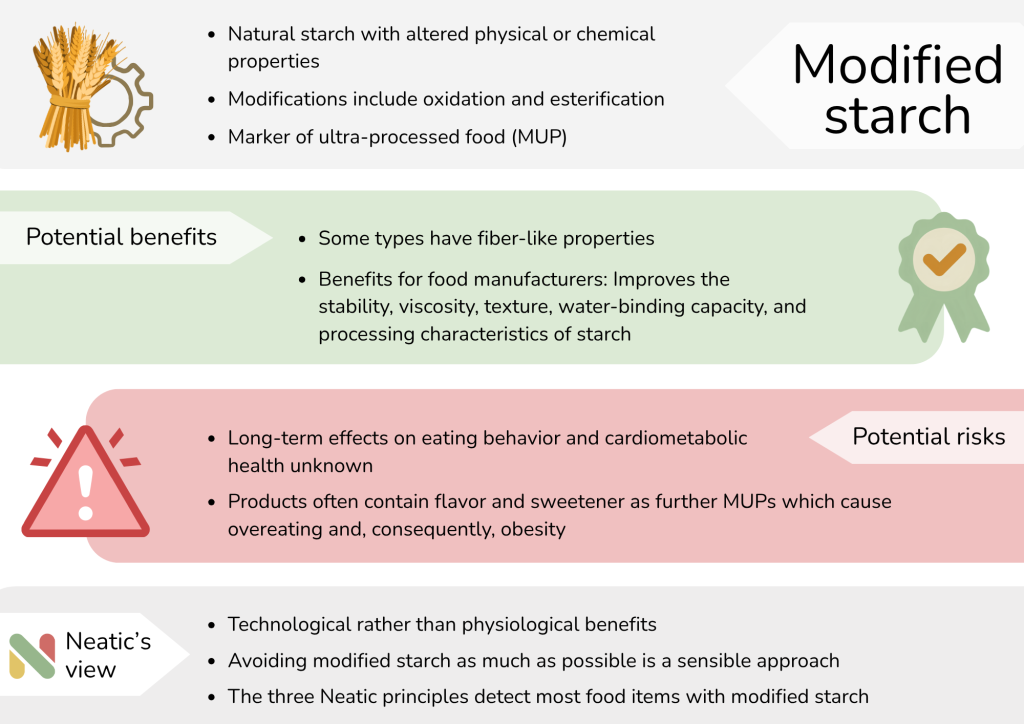
- Modified starch is a natural starch that has been treated to change its physical or chemical properties. These modifications allow manufacturers to control characteristics such as stability, viscosity, texture, water-binding capacity, and processing characteristics.
- Modified starch is a marker of ultra-processed food (MUP) and many products with modified starch also contain additional MUPs including added flavor, sweetener, and varieties of sugar.
- Some types of modified starch have fiber-like properties; however, no systematic studies have been performed to evaluate long-term effects of modified starch on eating behaviour and cardiometabolic health.
What is modified starch?
Modified starch is a natural starch that has been treated for example by oxidation or esterification to change its physical or chemical properties. Different types of modified starch have substantially different technological and nutritional characteristics. Due to its diverse properties, modified starch is widely used in the food industry.
Detailed information about natural starch is available here. In short, natural starch is a carbohydrate that provides 4 kcal of energy per gram and is present in foods such as grain, legumes, and potatoes.
What are the potential benefits of modified starch?
Improved product characteristics
Modified starch offers benefits for food manufacturers. It can improve the stability, viscosity, texture, water-binding capacity, and processing characteristics of starch. Different types of modified starch can serve as fat substitutes, thickeners, emulsifiers, stabilizers, and texturizing agents.
Fiber-like properties of resistant starch
Chemically modified starch that shows reduced digestion in the small intestine is classified as resistant starch type 4. Unlike rapidly digestible natural starch, resistant starch reaches the large intestine partially undigested and can therefore behave similarly to dietary fiber. A meta-analysis comprising 19 randomized controlled trials showed a small but significant improvement in fasting glucose by 0.09 mmol/l or 1.6 mg/dl in the groups treated with resistant starch.
What are the potential risks of modified starch?
Long-term effects unknown
Modified starch is a broad and heterogenous group of substances with different physical and chemical properties. No systematic studies have been performed to evaluate their long-term effects on eating behavior and cardiometabolic health.
Ultra-processed food, energy overconsumption, and obesity
According to the NOVA classification, modified starch is a marker of ultra-processed food (MUP). Therefore, by definition, every product containing modified starch is an ultra-processed food (UPF) item. Even worse, food items with modified starch often contain additional MUPs such as flavor and sweetener both of which cause overeating and obesity. If the preferential consumption of UPF leads to energy intake beyond requirements, weight gain and obesity develop.
What does Neatic recommend concerning modified starch?
Modified starch provides technological rather than physiological benefits. The three Neatic principles detect more than 75 % of all UPF and, therefore, also most food items with modified starch. If food items with modified starch are to be detected even more consistently, consumers can search ingredient lists for the signal words “modified starch”.
Bibliography
Gałkowska, Dorota; Kapuśniak, Kamila; Juszczak, Lesław (2023): Chemically Modified Starches as Food Additives. Molecules 28 (22). DOI: 10.3390/molecules28227543.
Xiong, Ke; Wang, Jinyu; Kang, Tong; Xu, Fei; Ma, Aiguo (2021): Effects of resistant starch on glycaemic control: a systematic review and meta-analysis. Br J Nutr 125 (11), pp. 1260–1269. DOI: 10.1017/S0007114520003700.