
Major points:
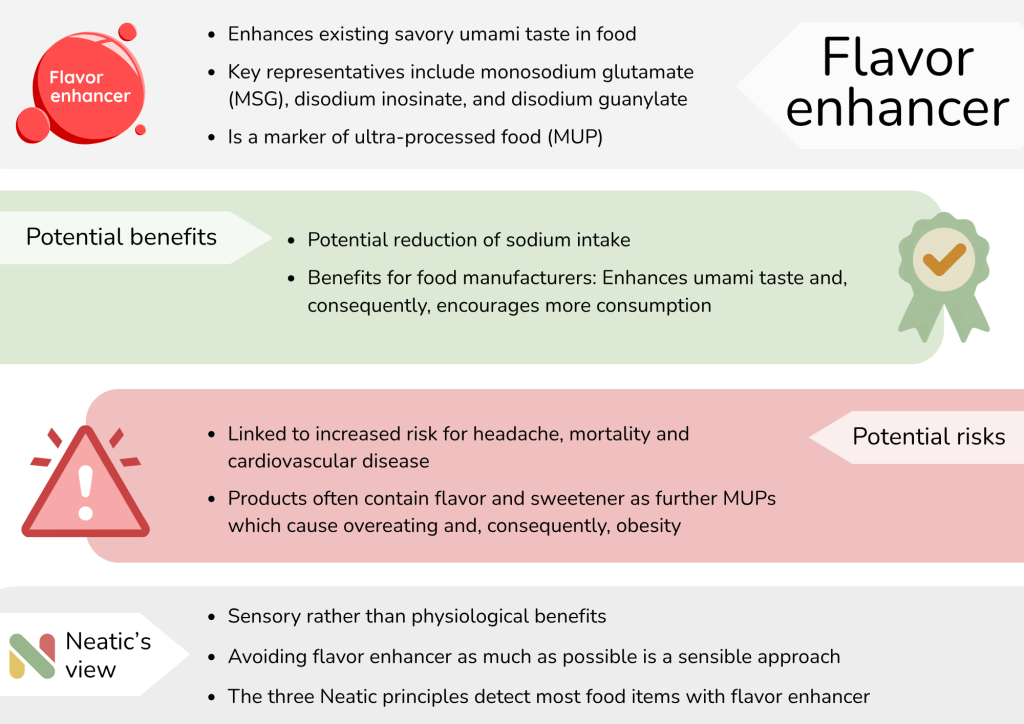
- Flavor enhancers are substances added to foods to primarily enhance their existing savory umami taste. Common flavor enhancers include monosodium glutamate (MSG), disodium inosinate, and disodium guanylate.
- Flavor enhancer is a marker of ultra-processed food (MUP) and many products with flavor enhancer also contain additional MUPs including added flavor, sweetener, and varieties of sugar.
- Flavor enhancers may help reduce sodium intake but potential risks including headache, cardiovascular disease, and mortality, require further investigation.
What are flavor enhancers?
Flavor enhancers are substances added to foods to primarily enhance their existing savory umami taste. Umami is one of the five basic tastes alongside sweet, sour, salty, and bitter. Umami is commonly described as a savory taste and is primarily elicited by glutamate.
The best-known flavor enhancer is monosodium glutamate (MSG), the sodium salt of the amino acid glutamic acid. Glutamate also occurs naturally in many foods with particularly high concentrations found in tomatoes and aged cheeses. Other commonly used flavor enhancers besides MSG include the nucleotides disodium inosinate and disodium guanylate which act synergistically with glutamate at umami taste receptors and can substantially increase the perceived intensity of umami.
What are the potential benefits of flavor enhancers?
Potential reduction of sodium intake
MSG can be used to reduce the sodium content of savory food while maintaining attractiveness. Sodium content by weight is approximately 39% in salt and 12% in MSG. In a sensory study comprising four different dishes, the addition of MSG to sodium-reduced foods maintained or even improved consumer acceptance compared with their conventional counterparts.
Enhanced umami taste
The primary benefit of commonly used flavor enhancers is the enhancement of umami taste. The synergistic interaction between MSG, disodium inosinate, and disodium guanylate allows a pronounced savory taste to be achieved with relatively small amounts of these flavor enhancers. For food manufacturers, flavor enhancers offer the benefit of intensifying existing flavors, potentially reducing the amount of natural ingredients needed to achieve an intense taste.
What are the potential risks of flavor enhancers?
“Chinese restaurant syndrome” and headache
Concerns that MSG may cause adverse symptoms date back to the so-called “Chinese restaurant syndrome”, first described in 1968 following reports of symptoms after eating at Chinese restaurants. MSG was subsequently suspected as a potential cause and headache became one of the lead symptoms. However, a review of four decades of research concluded that clinical studies failed to demonstrate a consistent relationship between MSG consumption and symptoms attributed to the “Chinese restaurant syndrome”. A systematic review of human studies published in 2016 further concluded that the available evidence does not establish that MSG causes headache.
Increased risk for mortality and cardiovascular disease
In a recent prospective cohort study with UK Biobank participants, higher intake of food items containing flavor enhancer was slightly but significantly associated with an increased risk of mortality. A study from the NutriNet-Santé prospective cohort found a positive association between MSG intake and cardiovascular disease risk. These exploratory studies cannot establish causality and, therefore, further mechanistic studies are necessary to better understand the role of flavor enhancer in mortality and cardiovascular disease. No significant relation between flavor enhancer and arterial hypertension risk, as well as depression risk, was observed in recent studies with UK Biobank participants.
Ultra-processed food, energy overconsumption, and obesity
According to the NOVA classification, flavor enhancer is a marker of ultra-processed food (MUP). Therefore, by definition, every product containing flavor enhancer is an ultra-processed food (UPF) item. Even worse, food items with flavor enhancer often contain additional MUPs such as flavor and sweetener both of which cause overeating and obesity. If the preferential consumption of UPF leads to energy intake beyond requirements, weight gain and obesity develop.
What does Neatic recommend concerning flavor enhancers?
Flavor enhancer provides sensory rather than physiological benefits. The three Neatic principles detect more than 75% of all UPF and, therefore, also most food items with flavor enhancer. If food items with flavor enhancer are to be detected even more consistently, consumers can search ingredient lists for the signal word “flavor enhancer”.
Bibliography
Blumenthal, Annika Katja; Eichner, Gerrit; Fasshauer, Mathias; Eise, Nathalie Judith (2026): Relationship between 39 dietary markers of ultra-processed food and incident depression: evidence from the prospective UK Biobank cohort study. Eur J Nutr 65 (6). DOI: 10.1007/s00394-026-04084-7.
EFSA Panel on Food Additives and Nutrient Sources added toFood (EFSA ANS Panel); Mortensen, Alicja; Aguilar, Fernando; Crebelli, Riccardo; Di Domenico, Alessandro; Dusemund, Birgit et al. (2017): Scientific Opinion on there-evaluation of glutamic acid (E 620), sodium glutamate (E 621), potassium glutamate (E 622),calcium glutamate (E 623), ammonium glutamate (E 624) and magnesium glutamate (E 625) as foodadditives. EFSA Journal 15 (7), e04910. DOI: 10.2903/j.efsa.2017.4910.
Freeman, Matthew (2006): Reconsidering the effects of monosodium glutamate: a literature review. J Am Acad Nurse Pract 18 (10), pp. 482–486. DOI: 10.1111/j.1745-7599.2006.00160.x.
Halim, Jeremia; Bouzari, Ali; Felder, Dan; Guinard, Jean-Xavier (2020): The Salt Flip: Sensory mitigation of salt (and sodium) reduction with monosodium glutamate (MSG) in “Better-for-You” foods. J Food Sci 85 (9), pp. 2902–2914. DOI: 10.1111/1750-3841.15354.
Hasenböhler, A.; Javaux, G.; La Payen de Garanderie, M.; Szabo de Edelenyi, F.; Agaësse, C.; Sa, A. de; Deschasaux-Tanguy, M.; Fezeu, L.; Srour, B.; Touvier, M. (2024): Food additive monosodium glutamate and risk of cardiovascular diseases – NutriNet-Santé cohort. Eur J Public Health 34 (Supplement_3), Article ckae144.234. DOI: 10.1093/eurpub/ckae144.234.
Krost, Kathrin Marie; Eichner, Gerrit; Fasshauer, Mathias; Eise, Nathalie Judith (2025): Association of 37 markers of ultra-processing with all-cause mortality: a prospective cohort study in the UK Biobank. EClinicalMedicine 88, p. 103448. DOI: 10.1016/j.eclinm.2025.103448.
Krost, Kathrin Marie; Eichner, Gerrit; Fasshauer, Mathias; Eise, Nathalie Judith (2026): Markers of ultra-processed food and incident arterial hypertension in the UK Biobank. Eur Heart J. DOI: 10.1093/eurheartj/ehag614.
Kurihara, Kenzo (2009): Glutamate: from discovery as a food flavor to role as a basic taste (umami). Am J Clin Nutr 90 (3), 719S-722S. DOI: 10.3945/ajcn.2009.27462D.
Kwok, R. H. (1968): Chinese-restaurant syndrome. N Engl J Med 278 (14), p. 796. DOI: 10.1056/NEJM196804042781419.
Obayashi, Yoko; Nagamura, Yoichi (2016): Does monosodium glutamate really cause headache? : a systematic review of human studies. J Headache Pain 17, p. 54. DOI: 10.1186/s10194-016-0639-4.