
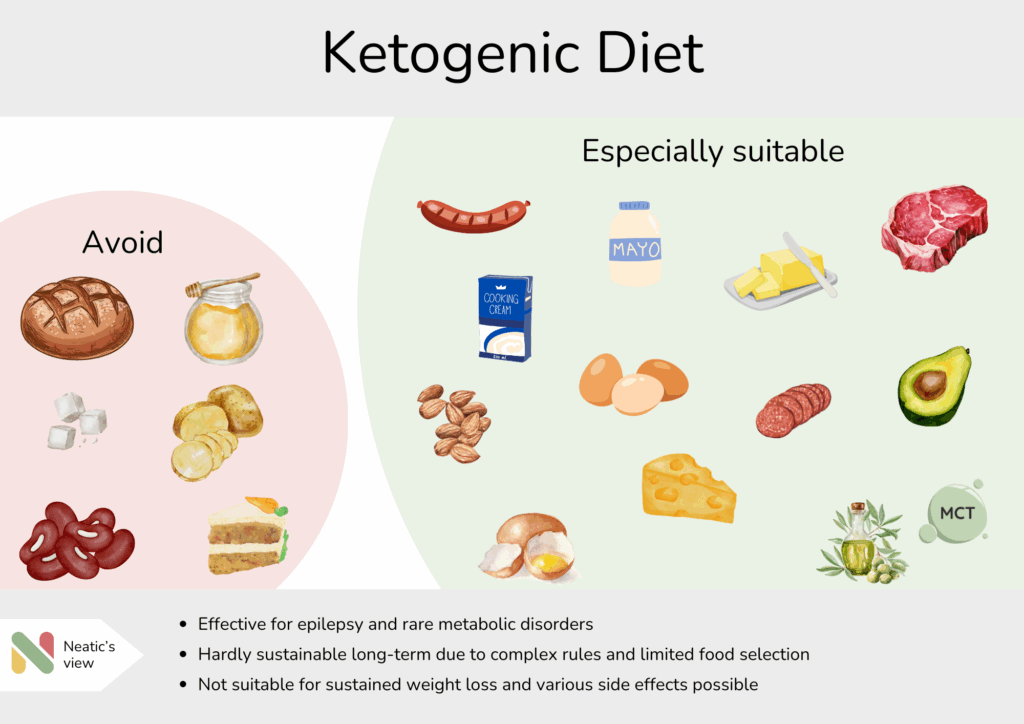
Major points:
- The ketogenic diet is an eating pattern that focuses heavily on the consumption of fats while drastically restricting carbohydrate intake.
- It has been proven to have a therapeutic effect on epileptic disorders and rare metabolic diseases. However, its effects on body weight are comparable to calorie-reduced diets.
- Neatic considers the ketogenic diet outside of these specific medical indications to be not meaningful. In particular, it should not be used for weight reduction.
What is the ketogenic diet?
The ketogenic diet is an eating pattern that focuses heavily on the consumption of fats while drastically restricting carbohydrate intake. The name “ketogenic” comes from the so-called “ketosis.” The body enters this metabolic state when it mainly uses fat as an energy source instead of carbohydrates.
How does ketosis work?
Normally, the body uses carbohydrates as its primary energy source. Carbohydrates are broken down into sugar (glucose), which is then burned by the cells to produce energy. Amino acids, the building blocks of proteins, can also be converted into sugar and burned. However, there is no way for fat to be converted into sugar.
When hardly any carbohydrates and proteins are eaten, the glucose stores in the body are depleted. After a few days, the body is forced to switch to an alternative energy source: the so-called ketone bodies, which are produced in the liver from fat. There are three ketone bodies: β-hydroxybutyrate, acetoacetate and acetone. While β-hydroxybutyrate and acetoacetate can be used to produce energy, acetone is exhaled through the lungs.
Almost all cells in the body can switch from glucose to ketone bodies as an energy source. An exception is the liver, as it lacks an enzyme for breaking down ketone bodies. Red blood cells also cannot use ketone bodies because they lack the mitochondria necessary for metabolism. The state in which the body predominantly uses ketone bodies as an energy source is called ketosis. Achieving this state is the main goal of the ketogenic diet.
What forms of ketogenic diets exist?
All forms share a strict limitation of carbohydrates. Less than 10 percent of dietary energy comes from carbohydrates. In a 2000 kilocalorie diet, 10 percent of the energy corresponds to about 50 g of carbohydrates. This amount is contained, for example, in 68 g of rice, 100 g of multigrain bread or 500 g of banana. Thus, carbohydrate restriction in the ketogenic diet is usually much stricter than in conventional low-carb diets. In addition, many ketogenic diets do not ensure adequate intake of essential nutrients, so supplements must be taken.
The main forms of the ketogenic diet are:
- Classic ketogenic diet
A so-called ketogenic ratio of 4:1 or 3:1 is specified. This ratio refers to the proportion of fats to carbohydrates and proteins in grams. In a classic 4:1 diet, 4 g of fat are consumed for every 1 g of carbohydrates and proteins. In terms of energy, this means that 90 percent of dietary energy comes from fat and only 10 percent from carbohydrates and proteins. In a 3:1 diet, 87 percent of energy still comes from fat, while carbohydrates and proteins make up 13 percent combined. - Modified Atkins diet (MAD)
The focus is on limiting carbohydrates. The intake of fat and protein can be designed somewhat “more freely” compared to the classic ketogenic diet. The fat content of food is often about 70 percent of energy intake and thus lower than in the classic variant. - Low glycemic index treatment (LGIT)
This diet has a similar ratio of fat, carbohydrates and proteins as the modified Atkins diet. In addition, it emphasizes foods that cause a lower increase in blood sugar. The blood sugar-increasing effect of a food is measured by the glycemic index. Foods with a glycemic index of <50 are preferred, such as whole grain spaghetti, peas, apples and bell peppers. - Medium chain triglycerides diet (MCT diet)
In this variant, medium chain triglycerides (MCTs) are used as the main energy source, making up between 30 percent and 60 percent of dietary energy. Unlike long chain fatty acids naturally found in food, MCTs are transported directly to the liver and converted into ketone bodies there. This form of diet is often advertised as more flexible because no ketogenic ratio has to be maintained. However, MCTs are synthetically produced, have limited culinary properties and can cause gastrointestinal discomfort. Therefore, this form is rarely used.
Why do people follow a ketogenic diet?
The reasons for following a ketogenic diet are diverse:
- Therapy-resistant epileptic disorders: Especially in epilepsy that does not respond to medication.
- Rare metabolic diseases: Examples include glucose transporter type 1 deficiency syndrome and pyruvate dehydrogenase deficiency.
- Weight loss: Many people hope for permanent weight loss. It is often claimed that fat breakdown is promoted because the body uses fat as its main energy source. In addition, a stable blood sugar level and reduced food cravings are said to support success.
- Other applications: Tumors, Alzheimer’s disease, Parkinson’s disease, autism, bipolar disorder, migraine and multiple sclerosis. Many of these applications, however, are not scientifically proven (see “What does science say?”).

What foods are allowed?
The ketogenic diet requires careful selection of foods because carbohydrate intake is severely restricted. The following foods are particularly suitable:
- Fatty meats and high-fat sausages
- High-fat dairy products such as cream, crème fraîche, sour cream, mascarpone
- Vegetable oils, including MCT oil
- Mayonnaise
- Eggs
- Plant products with high fat content such as almond butter, avocados, flaxseed and nuts
In addition, substitute products that imitate carbohydrate-rich foods are often used. Examples include:
- Grated cauliflower as a rice substitute
- Zucchini spirals as a pasta substitute
- Rice and pasta made from konjac root
- Guar gum and locust bean gum as thickeners
Fats are also often additionally integrated or “hidden.” Examples include:
- Stirring cream or oil into soups, quark, yogurt, mashed potatoes or scrambled eggs
- Adding butter or margarine to cooked vegetables
- Processing cream with locust bean gum or guar gum into sauces or pudding
- Using mayonnaise for salads or dips
- Frying bread in fat
- Gratinating dishes with cheese
- Drinking oil before eating or adding it to coffee
- “High-fat” cooking methods, such as fried potatoes instead of boiled potatoes
On the other hand, carbohydrate-rich foods should be avoided. More information on carbohydrates and their distribution can be found here.
How is ketosis detected?
There are three ways to detect ketosis in the body:
- Blood tests: The ketone body β-hydroxybutyrate can be measured by blood tests. The measurement works similarly to blood sugar measurement in diabetes mellitus patients.
- Urine strip tests: Here, the ketone body acetoacetate is detected. This method is simple and inexpensive but less precise.
- Breath tests: The ketone body acetone can be detected in exhaled air.
In practice, one of these three methods is usually used. Depending on the device and method, different target ranges for ketosis may apply.
What side effects are there?
The ketogenic diet can have a variety of side effects:
- “Keto flu”: During the first few days, symptoms such as headache, fatigue, nausea and irritability may occur. This is a reaction to the withdrawal of carbohydrates and usually subsides after a few days.
- Water loss: The breakdown of carbohydrates stored as glycogen leads to a loss of the water bound to glycogen. In addition, ketone bodies are excreted in the urine, resulting in further fluid loss.
- Hypoglycemia: The drastic reduction of carbohydrate intake and depletion of glycogen stores can lead to hypoglycemia. This manifests as symptoms such as food cravings, trembling and concentration problems.
- Constipation: Due to the often low fiber intake, many people on the ketogenic diet suffer from constipation.
- Vitamin and micronutrient deficiencies: Due to the low intake of fruits and vegetables, the supply of vitamins and micronutrients may be inadequate. Supplements can help, but they do not always fully cover needs.
- Increased blood fats: The high fat intake often leads to an increase in LDL cholesterol levels. To what extent this increases the risk of vascular diseases such as heart attacks and strokes is still unclear. Triglycerides, on the other hand, decrease on the ketogenic diet.
- Kidney dysfunction: The increased excretion of ketone bodies can stress the kidneys, especially in people with pre-existing kidney diseases.
- Restricted food choices: The drastic reduction of carbohydrates means that many popular foods are eliminated. This can lead to social and practical challenges, for example when eating out.
Particular caution is required for pregnant women, breastfeeding women, children and adolescents as well as people with kidney or liver diseases.
What does science say?
In 2023, the effects of the ketogenic diet were summarized in a comprehensive review article in the journal BMC Medicine. The ketogenic diet showed clear effectiveness in therapy-resistant forms of epilepsy and certain metabolic diseases. For weight reduction, studies with only low or very low reliability were identified. For endpoints such as cancer, Alzheimer’s disease, Parkinson’s disease, autism, bipolar disorder, migraine or multiple sclerosis, no convincing evidence was found. Studies with high reliability showed an increase in LDL cholesterol, while triglycerides decreased on the ketogenic diet.
Another systematic review showed that the ketogenic diet significantly contributes to reducing seizures in children and adolescents with therapy-resistant epilepsy.
In a meta-analysis, the effects of the ketogenic diet in type 2 diabetes mellitus patients were examined. The results showed a 0.2 kg better weight loss compared to calorie-reduced diets. However, this difference was not statistically significant.
What does Neatic recommend concerning the ketogenic diet?
Neatic considers the ketogenic diet outside of specific medical indications such as therapy-resistant epilepsy and rare metabolic disorders to be not meaningful. In particular, it should not be used for weight reduction.
Bibliography
Choy, Kimberley Yu Ching; Louie, Jimmy Chun Yu (2023): The effects of the ketogenic diet for the management of type 2 diabetes mellitus: A systematic review and meta-analysis of recent studies. Diabetes Metab Syndr 17 (12), p. 102905. DOI: 10.1016/j.dsx.2023.102905.
Patikorn, Chanthawat; Saidoung, Pantakarn; Pham, Tuan; Phisalprapa, Pochamana; Lee, Yeong Yeh; Varady, Krista A.; Veettil, Sajesh K.; Chaiyakunapruk, Nathorn (2023): Effects of ketogenic diet on health outcomes: an umbrella review of meta-analyses of randomized clinical trials. BMC medicine 21 (1), p. 196. DOI: 10.1186/s12916-023-02874-y.
Sourbron, Jo; Klinkenberg, Sylvia; van Kuijk, Sander M. J.; Lagae, Lieven; Lambrechts, Danielle; Braakman, Hilde M. H.; Majoie, Marian (2020): Ketogenic diet for the treatment of pediatric epilepsy: review and meta-analysis. Childs Nerv Syst 36 (6), pp. 1099–1109. DOI: 10.1007/s00381-020-04578-7.