
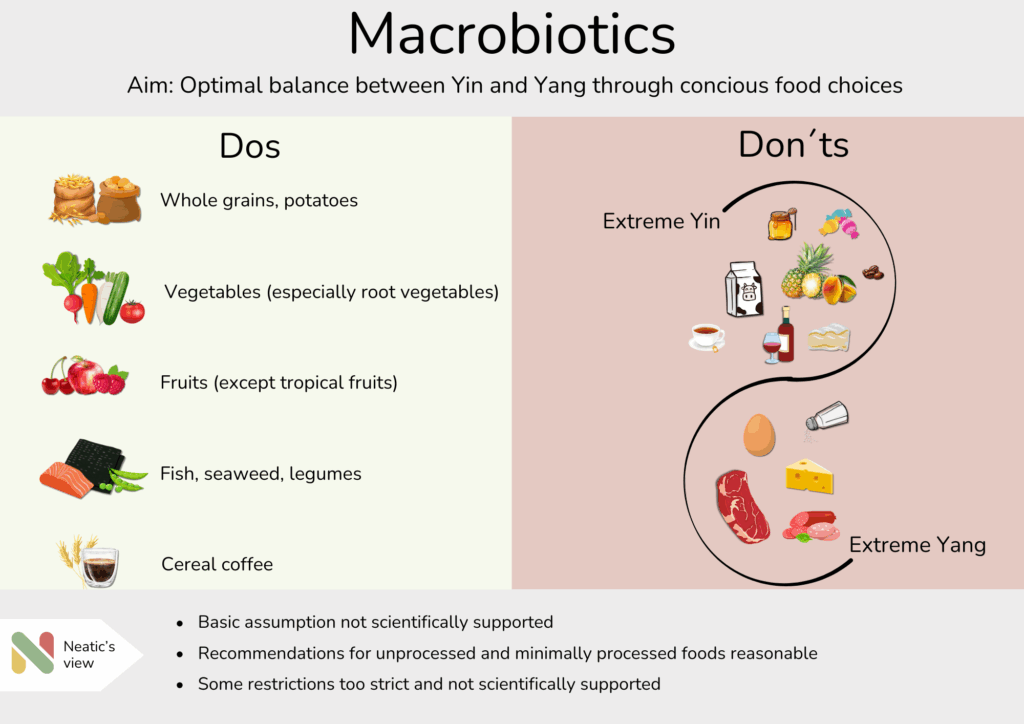
Major points:
- Macrobiotics is a system originating from Japan that, in addition to a plant-based diet, includes holistic practices such as acupressure, shiatsu, and meditation.
- Macrobiotics gives reasonable dietary recommendations, such as preferring unprocessed foods. However, some recommendations, such as avoiding milk, curd, and eggs, are not supported by solid data and are, therefore, too strict.
- Neatic considers the theoretical foundation of Macrobiotics to be scientifically unfounded. Some dietary recommendations, as well as the positive attitude towards acupressure, shiatsu, and meditation, are meaningful.
What is Macrobiotics?
The term “Macrobiotics” comes from the Greek words “makro” (large) and “bios” (life) and roughly means “the great life” or “life in abundance”. The philosophy of Macrobiotics was popularized in the West primarily by the Japanese philosopher George Ohsawa (1893 to 1966). Ohsawa combined traditional Japanese dietary teachings with Western science and Eastern spirituality. His student Michio Kushi (1926 to 2014) continued his work and significantly modified Macrobiotic principles. Kushi spread Macrobiotics in the United States and Europe and helped to bring the connection between nutrition, health, and spiritual balance into focus. Macrobiotics is understood not only as a diet but as an art of living aimed at bringing body, mind, and soul into harmony.
What role do Yin and Yang play in Macrobiotics?
At the core of Macrobiotics is the principle of Yin and Yang, two opposing but complementary energies that play a central role in East Asian philosophy. Yin and Yang symbolize the duality of the world: day and night, cold and warmth, rest and activity. In Macrobiotics, this principle is applied to diet and lifestyle.
Yin stands for expansion, cold, and feminine energy, while Yang stands for contraction, warmth, and masculine energy. An imbalance of Yin or Yang in the diet is considered the cause of physical and mental complaints. The goal of Macrobiotic nutrition is to create an optimal balance between Yin and Yang in the body through conscious food choices.
What dietary recommendations are given?
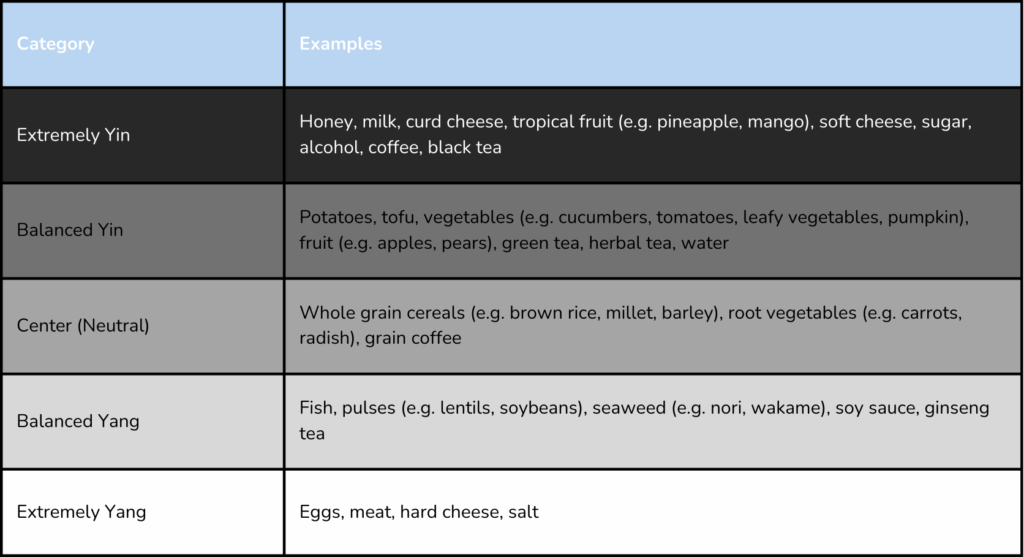
In Macrobiotics, foods are divided into one of five categories: extreme Yin, moderate Yin, neutral (middle), moderate Yang and extreme Yang. According to Macrobiotic principles, extreme Yin and extreme Yang foods should be avoided or consumed only rarely, as they influence energetic balance too strongly. The neutral category is seen as the ideal basis for nutrition because it represents a balance between Yin and Yang.
The following table assigns important foods to these categories:
Ohsawa originally described a stepwise transition to Macrobiotic nutrition over ten stages. The starting point was a conventional mixed diet with a high proportion of animal and processed foods. In the middle stages, the focus shifted to plant-based, unprocessed foods such as grains, vegetables and legumes, while consumption of animal products and spices was reduced. In the final stages, the diet became increasingly restrictive until, at stage 10, only whole grain rice and water were consumed. Each stage was supposed to enable a higher degree of balance and harmony with the principles of Yin and Yang. Ohsawa also claimed that the human body could synthesize vitamin C itself if it was in a perfect state of balance and health.
While Ohsawa taught a strict version of Macrobiotics, Kushi made Macrobiotics more flexible and individualized so that it could be adapted to climate, season, health status, and personal needs. He also expanded the food selection by integrating a greater variety of vegetables, legumes, and fermented products such as miso and tempeh to better meet nutrient needs and make implementation more practical. In contrast to Ohsawa’s extreme recommendations, Kushi advocated a more balanced diet with a wider range of foods. Kushi also promoted practices such as meditation, exercise, and conscious design of the living environment to support holistic health.
What does modern Macrobiotic nutrition consist of?
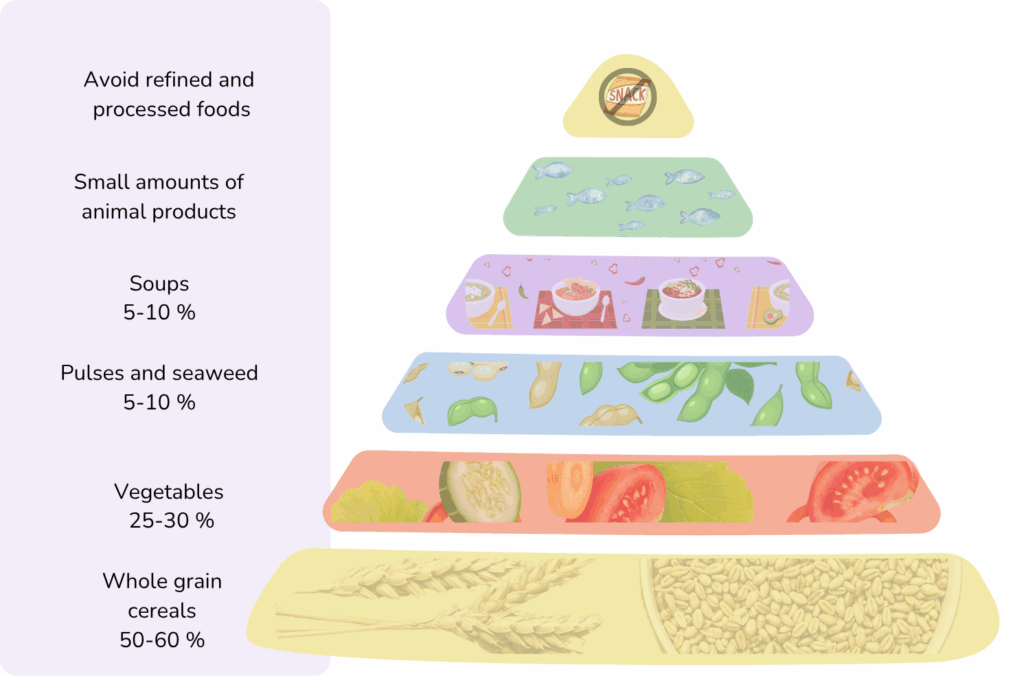
Modern Macrobiotic nutrition consists of the following components:
- Whole grain cereals (50-60 percent of daily food intake): These include rice, millet, barley, oats, and buckwheat. Whole grains are considered the most balanced and energetically stable foods.
- Vegetables (25-30 percent of daily food intake): Root vegetables, leafy greens, and squashes are particularly recommended. Whenever possible, vegetables are lightly steamed or sautéed.
- Pulses and seaweed (5-10 percent of daily food intake): These include soybeans, chickpeas, lentils, and sea vegetables such as nori, wakame, and kombu.
- Soups (5-10 percent of daily food intake): This includes traditional soups such as miso soup or tamari soup.
- Small amounts of animal products: Fish is consumed occasionally, while meat and dairy products are largely avoided.
- Avoidance of refined and processed foods: This includes sugar, white flour, processed snacks, and artificial additives.
What therapies exist in addition to dietary recommendations?
In addition to diet, Macrobiotics includes numerous therapeutic approaches intended to promote the balance of Yin and Yang on physical, mental, and emotional levels. These include physical exercise and breathing exercises, as well as a combination of stretching exercises, massage, meditation, and mindfulness, to improve the flow of energy in the body. Acupressure and shiatsu, which release blockages by stimulating energy points, also play an important role in restoring harmony between Yin and Yang. A structured lifestyle with regular sleep patterns and moderate stress is also recommended, while natural materials for clothing and furniture are said to contribute to balance.
In 2014, Soare and colleagues conducted a three-week randomized controlled study to investigate how a Macrobiotic diet (Ma-Pi 2 diet) compares with a calorie-reduced diet in type 2 diabetes mellitus. A total of 56 patients were included and evenly divided between the two interventions. Most participants successfully completed the study after three weeks. The Ma-Pi 2 group showed minimal improvements in blood sugar levels, cholesterol, and body weight compared to the calorie-reduced diet. However, not all differences were statistically significant, meaning that these differences could also have been due to chance and were not necessarily attributable to the intervention studied.
In addition, 40 participants were included in a follow-up study in which another form of Macrobiotic diet (Ma-Pi 4 diet) was compared with the original calorie-reduced diet over six months. Again, the Macrobiotic diet performed slightly better in terms of blood sugar levels, cholesterol, and body weight compared to the calorie-reduced diet.
Other therapeutic approaches of Macrobiotics also showed positive effects: acupressure relieves tumor pain, shiatsu relieves back pain, and meditation as well as mindfulness practices improve mental health.
The claim originally made by Ohsawa that the human body could synthesize vitamin C itself has been scientifically disproven.
What does Neatic recommend concerning Macrobiotics?
Macrobiotics gives reasonable dietary recommendations, such as emphasizing unprocessed or minimally processed foods, which aligns with Neatic principles. More information on ultra-processed foods can be found here. However, some recommendations, such as avoiding milk, curd, tropical fruits, soft cheeses, coffee, and black tea (extreme Yin), as well as eggs, meat, and hard cheese (extreme Yang), are not supported by solid data and are, therefore, too strict. Furthermore, the traditional concept of Yin and Yang is not needed for the meaningful dietary recommendations.
Bibliography
Drouin, Guy; Godin, Jean-Rémi; Pagé, Benoît (2011): The genetics of vitamin C loss in vertebrates. Curr Genomics 12 (5), pp. 371–378. DOI: 10.2174/138920211796429736.
He, Yihan; Guo, Xinfeng; May, Brian H.; Zhang, Anthony Lin; Liu, Yihong; Lu, Chuanjian; Mao, Jun J.; Xue, Charlie Changli; Zhang, Haibo (2020): Clinical Evidence for Association of Acupuncture and Acupressure With Improved Cancer Pain: A Systematic Review and Meta-Analysis. JAMA oncology 6 (2), pp. 271–278. DOI: 10.1001/jamaoncol.2019.5233.
Kobayashi, Daiki; Shimbo, Takuro; Hayashi, Hana; Takahashi, Osamu (2019): Shiatsu for chronic lower back pain: Randomized controlled study. Complementary therapies in medicine 45, pp. 33–37. DOI: 10.1016/j.ctim.2019.05.019.
Soare, A.; Del Toro, R.; Khazrai, Y. M.; Di Mauro, A.; Fallucca, S.; Angeletti, S.; Skrami, E.; Gesuita, R.; Tuccinardi, D.; Manfrini, S.; Fallucca, F.; Pianesi, M.; Pozzilli, P. (2016): A 6-month follow-up study of the randomized controlled Ma-Pi macrobiotic dietary intervention (MADIAB trial) in type 2 diabetes. Nutr & Diabetes 6 (8), e222. DOI: 10.1038/nutd.2016.29.
springermedizin.de (2023): The effect of the macrobiotic Ma-Pi 2 diet vs. the recommended diet in the management of type 2 diabetes: the randomized controlled MADIAB trial. Available online at https://www.springermedizin.de/the-effect-of-the-macrobiotic-ma-pi-2-diet-vs-the-recommended-di/25655140, updated on 7/13/2023, checked on 2/3/2025.
Wielgosz, Joseph; Goldberg, Simon B.; Kral, Tammi R. A.; Dunne, John D.; Davidson, Richard J. (2019): Mindfulness Meditation and Psychopathology. Annual review of clinical psychology 15, pp. 285–316. DOI: 10.1146/annurev-clinpsy-021815-093423.