
Major points:
- Ayurveda is a traditional Indian medical system that, in addition to dietary adjustments, also includes yoga, meditation, massages, and dietary supplements.
- Ayurveda gives some reasonable dietary recommendations, such as preferring unprocessed foods and paying attention to hunger and satiety.
- Neatic considers the theoretical foundation of Ayurveda to be scientifically unfounded. However, some dietary recommendations, as well as the positive attitude towards yoga, meditation and massages are meaningful.
What is Ayurveda?
Ayurveda is a traditional medical system that originated in India over 5,000 years ago and is often called the “mother of medicine”. The term “Ayurveda” comes from Sanskrit and consists of the words “Ayus” (life) and “Veda” (knowledge), meaning “knowledge of life”. This holistic health system aims to bring body, mind, and soul into harmony to promote health and well-being. Ayurveda uses a variety of practices, including diet, yoga and meditation, massages, dietary supplements, and cleansing therapies (panchakarma). In Europe and North America, Ayurveda is used less in medicine and more in the wellness sector.
What are the five elements and three doshas?
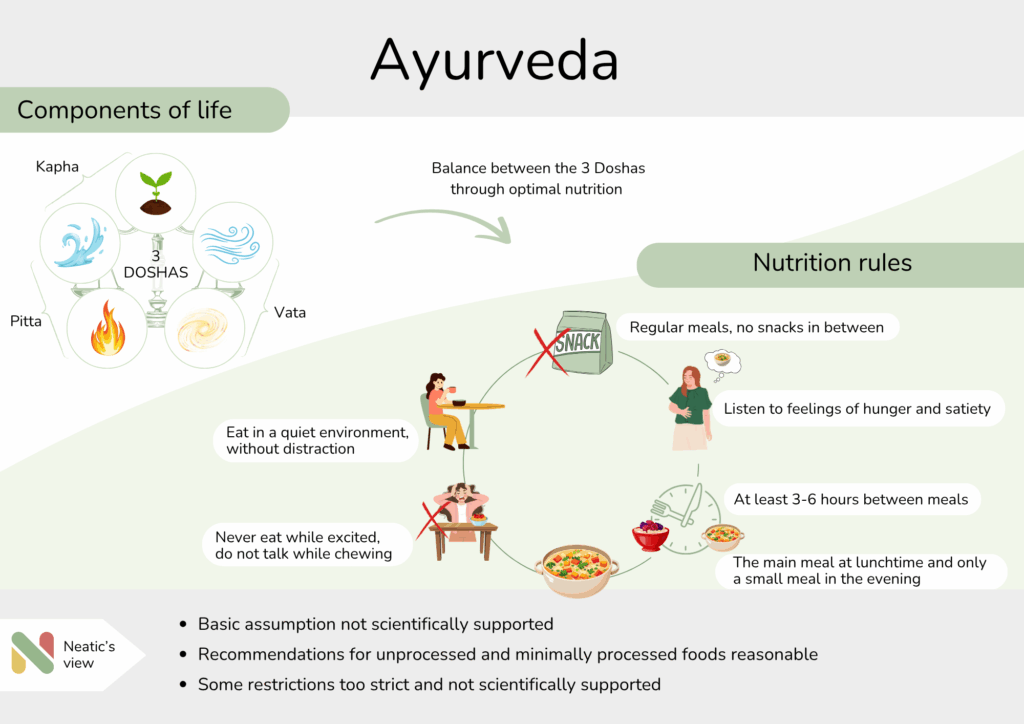
At the center of Ayurveda is the teaching of the five elements: earth, water, fire, air, and space (ether). These elements are considered the building blocks of life. Everything that exists contains these elements in different proportions, and these proportions are constantly changing. The five senses can also each be assigned to an element: smell corresponds to earth, taste to water, sight to fire, touch to air, and hearing to space.
The five elements manifest in the human body as three fundamental life energies, the so-called doshas: vata, pitta, and kapha.
- Vata represents the elements air and space. It regulates all movements in the body, including breathing, blood flow, and nerve signals.
- Pitta embodies fire and water. It controls digestion, metabolism, and body temperature.
- Kapha consists of earth and water. It provides stability, lubrication of the joints, and tissue building.
A balance of the doshas is crucial for health and well-being. Imbalances can lead to physical and mental complaints. Each person has an individual constitution called prakriti, which is based on the unique combination of the doshas:
- Vata type: Slim, energetic, creative, tends to have dry skin and irregular digestion.
- Pitta type: Medium build, goal-oriented, determined, tends to have skin irritations and heartburn.
- Kapha type: Sturdy build, calm, patient, tends to gain weight and have slow digestion.
There are also mixed types in which two or all three doshas dominate simultaneously.
What does diagnostics consist of?
Ayurvedic diagnostics aims to identify dosha imbalances and possible disorders in the body and to develop individual treatment strategies. It includes medical history, pulse diagnosis, tongue diagnosis, and physical examination.
Medical history involves a detailed interview with the patient. Daily routine, sleep habits, physical activity, diet, and complaints are specifically asked about. This helps identify possible causes of dosha imbalances and determine the patient’s individual constitution.
Pulse diagnosis (nadi pariksha) is a central method. The pulse is felt at three different points on the wrist, each assigned to one of the three doshas. The practitioner analyzes the speed, regularity, and strength of the pulse. This information is intended to provide clues about the current dosha balance, the energetic state of the organs, and possible disturbances or blockages.
Tongue diagnosis (jihva pariksha) is another important tool for assessing health status. The tongue is considered a reflection of the body, with specific areas assigned to different organs. The analysis includes tongue color, coating, cracks, swelling, and moisture.
In addition, there is a physical examination of skin, eyes, posture, gait, nails, hair, and body build. Constitution, as well as fat and muscle distribution, help to assess the patient’s dosha type.
What dietary recommendations are given?
Ayurvedic therapies aim to restore dosha balance.
The diet considers the following basic rules:
- Eat only when hungry.
- Eat regular meals, no snacks in between.
- Eat the main meal at midday, only light food in the evening.
- Eat in a quiet environment, without distractions or conversations.
- Never eat when agitated, and do not speak while chewing.
- Leave at least 3 to 6 hours between meals.
- Never eat to the point of being full.
The following general recommendations are made regarding foods:
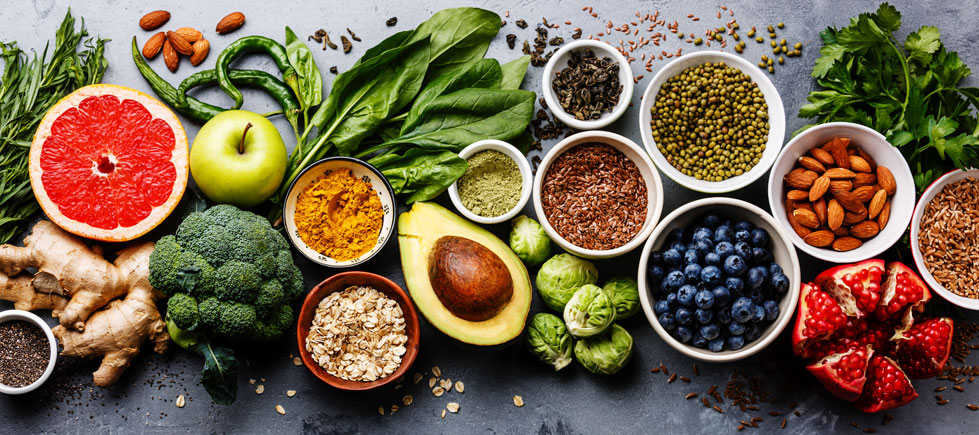
- Recommended: rice, ghee, sesame, fruits, vegetables, boiled milk, spring water, herbal tea, and spices such as turmeric, ginger, and cumin.
- Less recommended: meat, poultry, fish, eggs, cheese, processed foods.
- Forbidden: alcohol, coffee, carbonated drinks, chocolate.
- Fresh, easily digestible, and natural foods are preferred.
- The diet should also be balanced and wholesome; individual nutrients are not the focus.
Depending on individual constitution, there are additional specific recommendations:
- Vata type: Prefer warming, nourishing foods with healthy fats; avoid cold and dry foods.
- Pitta type: Prefer cooling, bitter, and sweet foods; reduce spicy, sour, and salty foods.
- Kapha type: Prefer light, dry, and warm foods; avoid heavy, oily, and sweet foods.
What therapies exist in addition to dietary recommendations?
The following four therapies complement the Ayurvedic dietary recommendations:
- Yoga and meditation: Yoga includes physical exercises (asanas), breathing techniques (pranayama), and stretching positions performed systematically. Meditation involves sitting in silence, focusing on breathing, or reciting mantras, often in guided sessions or individually.
- Massages: Ayurvedic massages are performed with warm oils enriched with herbs that are massaged into the skin. Special techniques such as shirodhara (oil pouring on the forehead) or dry massages with herbal powders are also used.
- Dietary supplements: Various forms such as teas, powders, tablets, or oils are prepared and used. They can also be applied as pastes on the skin or used for enemas.
- Panchakarma: Panchakarma includes five main methods, including therapeutic vomiting (vamana), purgation (virechana), enemas (basti), nasal cleansing (nasya), and bloodletting (raktamokshana), complemented by preparatory measures such as oil massages.
What does science say?
Despite the great popularity of Ayurveda, only limited reliable scientific data are available on its health effects.
A small pilot study showed that within nine months under Ayurvedic therapy, which included dietary recommendations and yoga, body weight was reduced by 5.9 kg. However, this study had no control group to compare therapy effects. The study was also very small, and of the original 17 participants, only data from 10 people were available after nine months.
There is ample evidence that yoga and meditation have health-promoting properties. A meta-synthesis of 19 reviews showed that a combination of various yoga techniques – such as physical exercises, breathing techniques, and meditation – has particularly effective therapeutic and preventive effects. These combined approaches were superior to interventions using only one technique for conditions such as high blood pressure, diabetes, or depression. An experimental study with 92 participants without yoga experience by the same team also examined the effects of different combinations of yoga practice components and found that the combination of yoga and meditation is particularly effective in reducing stress.
Health-promoting effects have also been described for massages. A systematic review showed that massage therapy leads to moderate short-term pain reduction and improved function (for example better mobility) in people with acute and chronic back pain. These effects were comparable to methods such as acupuncture or physical therapy. However, there were significantly fewer reliable studies on the long-term effects of massages.
Ayurvedic dietary supplements can contain significant amounts of toxic heavy metals such as lead, mercury, and arsenic, which can cause severe poisoning. Investigations by the Bavarian State Office for Health and Food Safety found that 60 percent of the samples tested contained such heavy metals, in some cases far exceeding guideline values. Consumers should, therefore, look for products with ISO 9001 certification and should not bring Ayurvedic products from abroad.
For panchakarma procedures such as enemas and therapeutic vomiting, there is no reliable scientific data. These invasive methods can cause serious side effects such as mucosal irritation, fluid loss, and circulatory problems.
What does Neatic recommend concerning Ayurveda?
Ayurveda gives reasonable dietary recommendations, such as preferring unprocessed foods and paying attention to hunger and satiety. In particular, the focus on unprocessed or minimally processed foods aligns with Neatic. More information on ultra-processed foods can be found here. However, some recommendations, such as banning coffee and chocolate and restricting cheese, are not supported by solid data and are, therefore, too strict. The specific recommendations depending on individual constitution are also not scientifically comprehensible. The traditional concepts of the five elements and three doshas are not needed for meaningful dietary recommendations.
Yoga and meditation have good evidence, especially for reducing stress, improving mental health, and promoting flexibility and well-being. Massages also show positive effects, especially in reducing stress, relieving pain, and supporting muscle recovery. However, the effectiveness of these treatments is also not dependent on the traditional concepts of the five elements and three doshas.
Ayurvedic dietary supplements should be viewed with caution, as in some cases they may contain heavy metal contamination and there is insufficient data on their effectiveness. Panchakarma procedures such as enemas and therapeutic vomiting are associated with considerable risks and should not be performed due to the lack of scientific basis.
Bibliography
Chou, Roger; Deyo, Richard; Friedly, Janna; Skelly, Andrea; Hashimoto, Robin; Weimer, Melissa; Fu, Rochelle; Dana, Tracy; Kraegel, Paul; Griffin, Jessica; Grusing, Sara; Brodt, Erika D. (2017): Nonpharmacologic Therapies for Low Back Pain: A Systematic Review for an American College of Physicians Clinical Practice Guideline. Ann Intern Med 166 (7), pp. 493–505. DOI: 10.7326/M16-2459.
Matko, Karin; Bringmann, Holger C.; Sedlmeier, Peter (2021): Effects of Different Components of Yoga: A Meta-Synthesis. OBM Integr Complement Med 06 (03), p. 1. DOI: 10.21926/obm.icm.2103030.
Matko, Karin; Sedlmeier, Peter; Bringmann, Holger C. (2021): Differential Effects of Ethical Education, Physical Hatha Yoga, and Mantra Meditation on Well-Being and Stress in Healthy Participants-An Experimental Single-Case Study. Front Psychol 12, p. 672301. DOI: 10.3389/fpsyg.2021.672301.
Rioux, Jennifer; Thomson, Cynthia; Howerter, Amy (2014): A Pilot Feasibility Study of Whole-systems Ayurvedic Medicine and Yoga Therapy for Weight Loss. Glob Adv Health Med 3 (1), pp. 28–35. DOI: 10.7453/gahmj.2013.084.
Verbraucherzentrale.de (2025): Ayurvedische Nahrungsergänzungsmittel | Verbraucherzentrale.de. Available online at https://www.verbraucherzentrale.de/wissen/lebensmittel/nahrungsergaenzungsmittel/ayurvedische-nahrungsergaenzungsmittel-5129, updated on 2/11/2025, checked on 2/11/2025.